



15 Sep Corporate Transportation for Private Aviation and FBO Arrivals in Southern California
Quick Answer: Private aviation transportation in Southern California should be coordinated around the exact airport or FBO, aircraft arrival information, passenger count, luggage, ground pickup instructions, vehicle requirements, and the executive’s next destination. Unlike a standard commercial-terminal pickup, a private aviation arrival may use a fixed-base operator or general aviation facility with its own access and pickup procedures. Confirm the FBO and approved meeting location before travel, then connect the arrival with the executive’s hotel, office, meeting, roadshow, event, or multi-city itinerary.
Key Takeaways
- Confirm the exact FBO or private aviation facility instead of providing only the airport name.
- Private aviation arrivals may use different facilities and pickup procedures from commercial airline terminals.
- The chauffeur should receive the approved ground pickup location and relevant arrival details before the aircraft arrives.
- A sedan may work well for an individual executive, while an SUV can provide additional room for passengers and luggage.
- Executive vans can simplify transportation when a corporate team arrives on the same aircraft and follows the same itinerary.
- Private aviation transportation can connect directly with meetings, hotels, roadshows, client visits, corporate events, and other Southern California destinations.
- Do not assume that a transportation vehicle can enter an aircraft ramp or secure airfield area. Access depends on the airport, FBO, security rules, permissions, and local operating procedures.
Private aviation changes the first stage of an executive’s ground transportation plan.
A traveler arriving on a commercial flight usually enters through a passenger terminal. A traveler arriving aboard a private or corporate aircraft may instead use a general aviation facility or fixed-base operator, commonly referred to as an FBO.
That distinction matters when arranging private aviation transportation in Southern California.
Giving a transportation company only the airport code may not be enough. The executive assistant, flight department, charter coordinator, or traveler should confirm the actual FBO or arrival facility, expected arrival information, passenger count, luggage requirements, approved pickup point, and next destination.
Corporate Executive Transportation provides corporate executive transportation for executives, business travelers, corporate groups, airport transfers, roadshows, client visits, and other professional travel throughout Southern California. Private aviation ground transportation can be planned as the first stage of that wider business itinerary.
Table of Contents
- What Is an FBO?
- FBO Arrival vs Commercial Airport Arrival
- What Information Should Be Provided Before an FBO Pickup?
- How to Coordinate a Private Aviation Arrival
- Private Aviation Airports and FBOs in Southern California
- Private Aviation Transportation at Ontario International Airport
- Private Aviation Transportation at John Wayne Airport
- Private Aviation Transportation at Van Nuys Airport
- Sedan, SUV or Sprinter for an FBO Arrival?
- Connecting an FBO Arrival With Meetings and Roadshows
- FBO Transportation Planning for Executive Assistants
- Ramp Access and Pickup Instructions
- Common Private Aviation Transportation Mistakes
- FBO Ground Transportation Checklist
- Frequently Asked Questions
What Is an FBO?
FBO stands for Fixed Base Operator.
The Federal Aviation Administration identifies FBO as the abbreviation for Fixed Base Operator. FAA airport guidance also describes FBOs as businesses that typically provide services to airport aeronautical users, which can include aircraft fuel, maintenance, hangar facilities, and other aviation support services.
For an executive traveler, the important point is simpler:
The FBO may be the location through which a private or corporate aviation passenger arrives and transitions to ground transportation.
Depending on the airport and flight operation, an FBO can provide or coordinate services such as:
- Passenger facilities
- Aircraft fueling
- Aircraft parking
- Ground handling
- Crew support
- Aircraft maintenance
- Flight planning
- Passenger lounges
- Concierge assistance
- Ground transportation coordination
Not every FBO offers exactly the same services, and operating procedures vary by airport and facility.
That is why a corporate transportation reservation should identify the actual FBO rather than assuming that all private flights use one common airport pickup area.
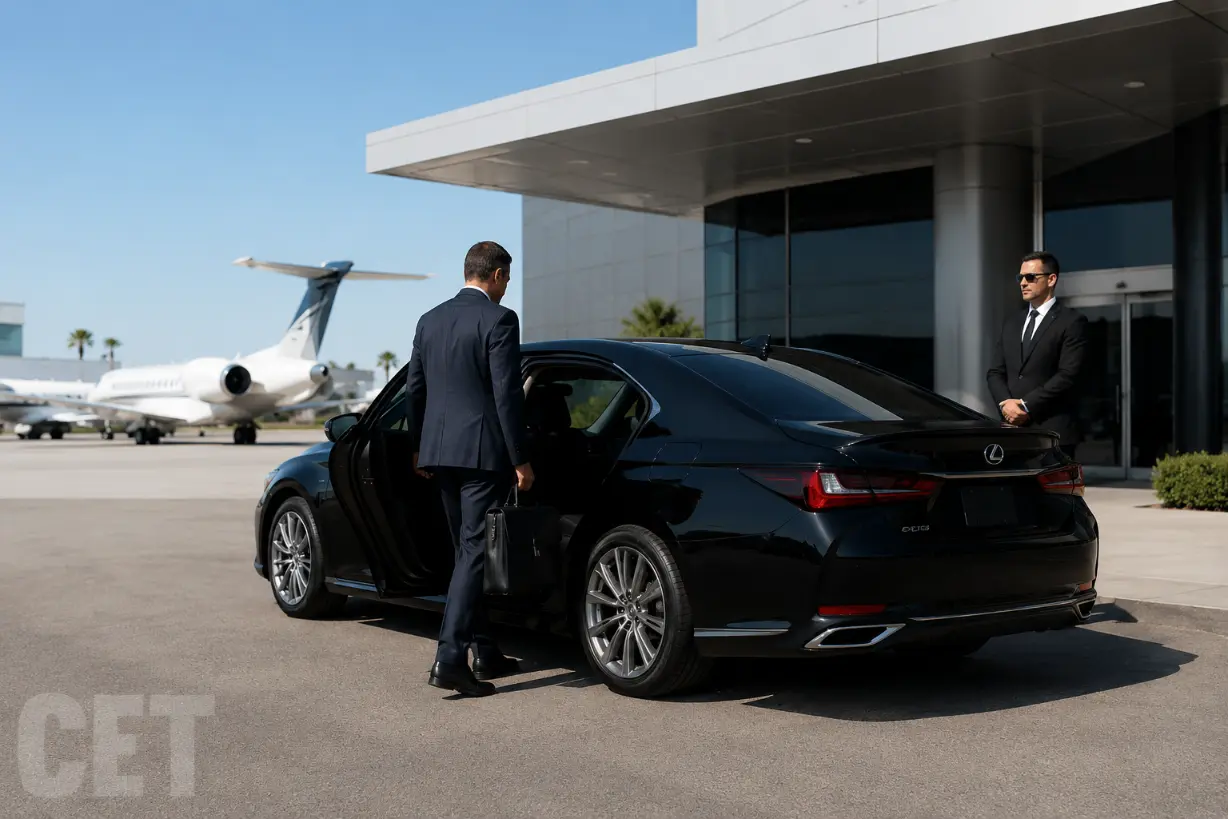
FBO Arrival vs Commercial Airport Arrival
A private aviation pickup should not automatically be handled like a commercial airline arrival.
The airport may be the same, but the passenger experience and ground pickup location can be completely different.
| Consideration | Private Aviation / FBO Arrival | Commercial Airline Arrival |
|---|---|---|
| Arrival facility | May use an FBO or general aviation facility. | Uses a commercial passenger terminal. |
| Pickup information | FBO name and approved pickup point may be essential. | Terminal, airline, flight, and designated airport pickup area are typically important. |
| Flight identification | May involve aircraft or charter details supplied by the passenger, flight department, or FBO. | Usually identified by airline and commercial flight number. |
| Ground access | Depends on airport, FBO, security requirements, and approved access areas. | Uses designated public commercial ground transportation areas. |
| Typical traveler | Private aircraft passengers, executives, corporate teams, charter passengers, aircraft owners, and guests. | Scheduled airline passengers. |
This difference is why transportation planners should avoid sending instructions such as “pick up at Ontario Airport” when the executive is actually arriving through a specific private aviation facility.
Instead, provide the exact location whenever it is known.
What Information Should Be Provided Before an FBO Pickup?
The more accurate the arrival information, the easier it becomes to coordinate the transfer from aircraft to ground transportation.
Before booking, gather:
- Traveler’s full name
- Passenger mobile number
- Travel date
- Airport
- Exact FBO or private aviation facility
- Expected aircraft arrival time
- Available flight, aircraft, charter, or tail information when appropriate
- Number of passengers
- Estimated luggage
- Approved ground pickup location or FBO instructions
- Destination after arrival
- Any scheduled business meeting after landing
- Additional transportation stops
- Return-flight or departure information when applicable
Pro Tip: Do not send only the airport code when booking an FBO pickup. If the executive is arriving through a private aviation facility, provide the FBO name and address or approved pickup instructions. Two private aircraft arriving at the same airport may use different facilities.
How to Coordinate Corporate Transportation for a Private Aviation Arrival
An FBO transfer becomes easier when the flight and ground transportation teams are working from the same basic information.
Step 1: Confirm the Actual Arrival Facility
Determine which airport and FBO the aircraft will use.
Do this before assuming that the public airline terminal is the appropriate transportation location.
Step 2: Confirm the Expected Arrival
Private aviation schedules can change for operational, weather, passenger, or aircraft reasons.
The transportation coordinator should provide the most useful arrival information available and communicate meaningful changes when they occur.
Step 3: Confirm the Ground Pickup Procedure
Ask the FBO, flight department, charter operator, or appropriate travel coordinator where the passenger should meet the vehicle.
Some locations may use a public FBO entrance or designated landside pickup area. Other procedures can differ according to local airport and security requirements.
Step 4: Confirm the Passenger and Luggage Requirements
A private aircraft may carry one executive or an entire business team.
Vehicle planning should therefore consider:
- Total travelers
- Suitcases
- Carry-on bags
- Presentation materials
- Golf bags or other oversized items
- Business equipment
Step 5: Connect the Arrival With the Business Itinerary
The FBO may only be the first transportation point.
The executive may need to continue directly to:
- Corporate headquarters
- A client meeting
- A board meeting
- A hotel
- A convention center
- A manufacturing facility
- A real estate tour
- An investor presentation
- A business lunch
- A corporate event
If those destinations are already known, include them in the original transportation planning.
Private Aviation Airports and FBOs in Southern California
Southern California business aviation is not concentrated at one airport.
Executives and corporate aircraft may use general aviation facilities across the Inland Empire, Orange County, Los Angeles County, and surrounding markets.
The appropriate airport can depend on aircraft requirements, origin, destination, operator preferences, business location, airport availability, and other flight-planning considerations.
Ground transportation planners should therefore work from the airport and FBO selected for the actual flight rather than assuming that every Los Angeles-area private aircraft uses LAX.
Examples of airports supporting private or general aviation activity include:
- Ontario International Airport
- John Wayne Airport
- Van Nuys Airport
- Long Beach Airport
- Chino Airport
- Riverside-area aviation facilities
- San Bernardino International Airport
- Other Southern California general aviation airports
The transportation requirement should then be built around where the executive actually needs to go after landing.
Private Aviation Transportation at Ontario International Airport
Ontario International Airport is particularly relevant to CET because of its location in the Inland Empire and access to Ontario, Rancho Cucamonga, Riverside, San Bernardino, Orange County, and surrounding Southern California business markets.
ONT maintains an official general aviation program centered on Guardian Jet Center.
According to Ontario International Airport’s official General Aviation information, Guardian Jet Center operates as a full fixed-base operation adjacent to the airport and provides services for private travelers arriving and departing Southern California.
The airport lists services including:
- Full-service fuel
- Ground handling
- Aircraft maintenance and cleaning
- Concierge services
- Passenger and crew facilities
- Ground transportation options
- Flight and weather planning
For a business traveler landing at ONT through an FBO, the ground itinerary could continue to:
- Ontario corporate offices
- Ontario Convention Center
- Rancho Cucamonga
- Riverside
- San Bernardino
- Orange County
- Los Angeles
- Another Southern California business destination
CET’s airport transportation service can also connect airport arrivals with business meetings, hotels, conferences, and other corporate travel requirements.
Private Aviation Transportation at John Wayne Airport
John Wayne Airport is another important private and corporate aviation location for business travel involving Orange County.
John Wayne Airport states that general aviation represents the majority of its aircraft operations and that the airport accommodates private aircraft ranging from smaller general aviation aircraft to corporate jets.
The airport’s official General Aviation Services directory currently lists full-service FBO operators at SNA, allowing flight departments and travel planners to confirm current private aviation facility information directly with the airport.
An executive arriving through an SNA FBO may continue to:
- Irvine
- Costa Mesa
- Newport Beach
- Anaheim
- Orange County corporate offices
- Convention or event venues
- Client meetings
- Los Angeles-area destinations
When the travel day includes several destinations, CET’s destination transportation can be considered as part of the wider executive itinerary.
Private Aviation Transportation at Van Nuys Airport
For business travel involving Los Angeles and the San Fernando Valley, Van Nuys Airport is another significant private aviation location.
Los Angeles World Airports describes VNY as an airport dedicated to noncommercial aviation and identifies it as a major location for private and corporate aircraft.
The official Los Angeles World Airports overview of Van Nuys Airport lists multiple major FBOs operating on the airport and notes VNY’s role in serving private, corporate, and government aviation.
An executive arriving at Van Nuys may need transportation onward to:
- Downtown Los Angeles
- Beverly Hills
- Century City
- Hollywood-area business destinations
- Burbank
- San Fernando Valley offices
- West Los Angeles
- Orange County
- Other regional business locations
The key planning principle remains unchanged: confirm the FBO first, then build transportation around the executive’s next destination and required arrival time.
Sedan, SUV or Sprinter for an FBO Arrival?
Private aviation does not automatically require one particular type of ground vehicle.
The correct choice depends on the travelers and what they are carrying.
Executive Sedan
A sedan may work well for:
- One executive
- A small business party
- Limited luggage
- FBO-to-office transportation
- Individual client meetings
- Hotel transfers
- Business dinners
CET’s premium sedan chauffeur service provides another transportation format for individual executives and visiting business travelers.
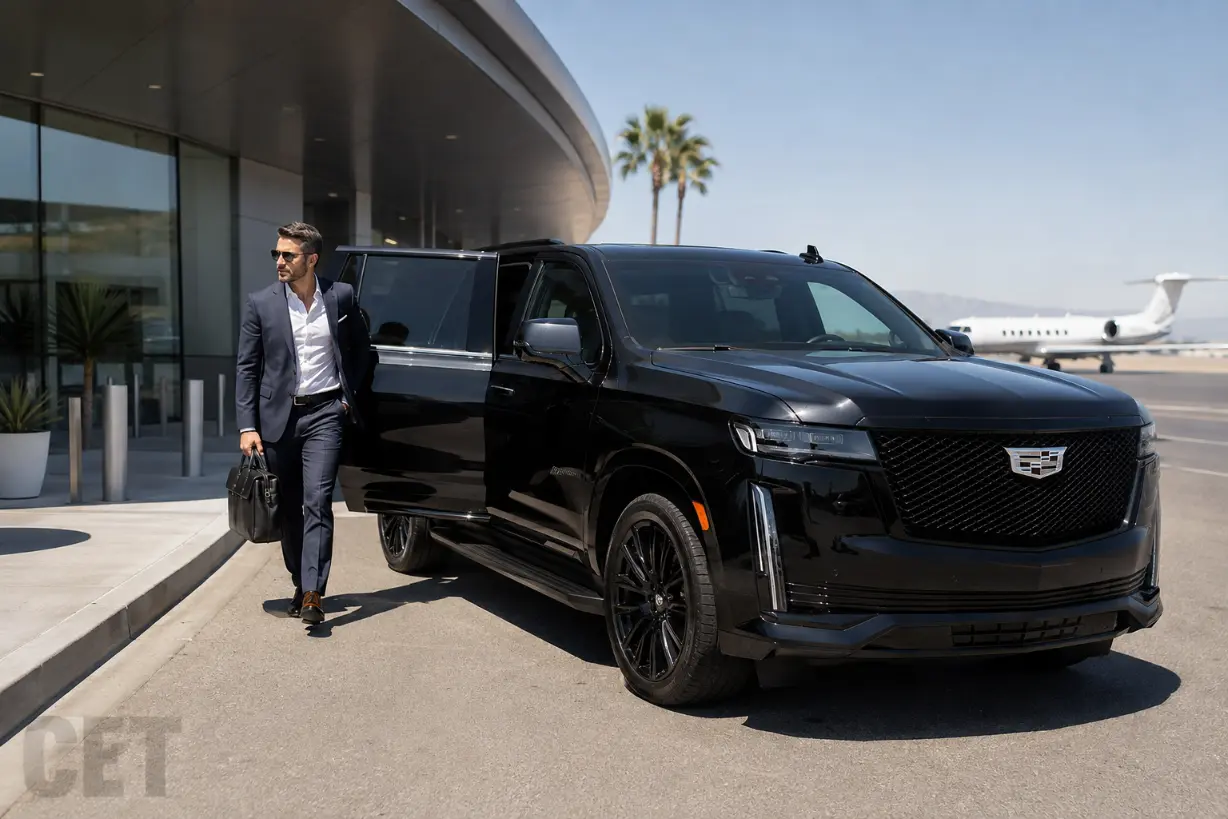
Luxury SUV
An SUV can make more sense when a private aviation arrival includes:
- Additional passengers
- Several checked bags
- Business materials
- Presentation equipment
- Golf bags
- Other large items
CET’s fleet includes a Cadillac Escalade ESV for suitable executive and corporate transportation requirements.
Mercedes-Benz Sprinter or Executive Van
Corporate aircraft can also carry teams traveling together.
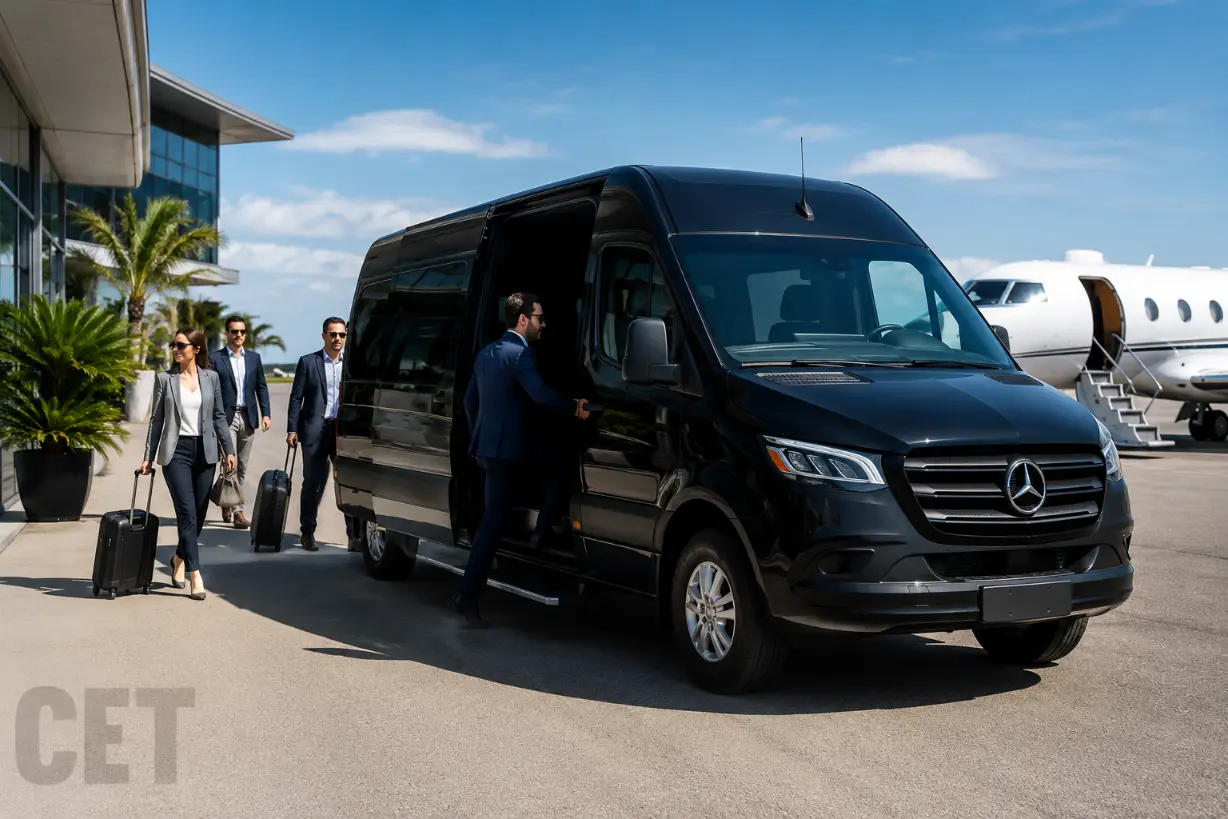
If several executives, employees, clients, consultants, or investors arrive on the same aircraft and follow the same itinerary, an executive van can reduce the need to coordinate multiple separate cars.
CET’s fleet includes a 10-passenger Mercedes-Benz Sprinter Executive Limousine for appropriate corporate group transportation.
Connecting an FBO Arrival With Meetings and Corporate Roadshows
Private aviation is often selected because the flight itself supports a demanding business schedule.
The ground transportation plan should support that same objective.
An executive may land and immediately begin an itinerary such as:
- FBO arrival
- Corporate headquarters
- Investor meeting
- Business lunch
- Second client presentation
- Regional office visit
- Business dinner
- Hotel
That should not be planned as though the passenger only needs an airport transfer.
FBO Arrival to Corporate Roadshow
A private aircraft may allow an executive to begin a multi-city Southern California business schedule immediately after landing.
CET’s guide to corporate roadshow transportation in Southern California explains how to coordinate meeting locations, required arrival times, regional routes, hotels, airports, and schedule changes throughout a multi-city executive itinerary.
FBO Arrival to Multi-Stop Business Day
If the executive has several closely connected stops after landing, an hourly or more continuous transportation arrangement may deserve consideration.
CET’s hourly executive car service guide explains how multi-stop business travel can differ from individual point-to-point reservations.
The best structure depends on the actual itinerary.
Private Aviation Transportation Planning for Executive Assistants
Executive assistants often arrange FBO transportation from another office and may never see the airport or aircraft themselves.
This makes accurate information especially important.
Do Not Assume the Airport Terminal
If the itinerary says “ONT,” “SNA,” “VNY,” or another airport identifier, determine whether the passenger is using a commercial terminal or private aviation facility.
Ask for the FBO Name
The flight department, private aviation provider, traveler, charter operator, or trip confirmation may identify the FBO.
Confirm the Next Business Destination
Do not plan only the airport arrival when the executive immediately continues to an appointment.
Provide Passenger Contact Information
The person making the reservation and the person entering the vehicle may not be the same individual.
Build the FBO Transfer Into the Master Itinerary
For example:
| Trip Stage | Information to Record |
|---|---|
| Aircraft arrival | Airport, FBO, expected arrival, passenger information |
| Ground pickup | Approved meeting point and relevant FBO instructions |
| Vehicle | Sedan, SUV, executive van, passenger count, luggage |
| First destination | Complete address and required arrival time |
| Additional stops | Meetings, hotel, meals, client visits, events |
| Departure | Return FBO, departure timing, passengers, luggage |
For a broader corporate travel workflow, CET’s Executive Assistant’s Guide to Arranging Corporate Transportation covers itinerary management, airport travel, vehicles, communication, and schedule changes.
Can the Chauffeur Pick Up Passengers Planeside?
This should never be assumed.
Aircraft ramps and airfield areas are controlled environments. Whether a ground transportation vehicle can access a secure area depends on the airport, FBO, operating procedures, security requirements, permissions, and the specific trip.
For example, John Wayne Airport maintains specific general aviation security and badging requirements for personnel accessing controlled airport areas.
The practical booking rule is:
Ask the FBO where the transportation vehicle is authorized to meet the passenger and follow those instructions.
Do not advertise or promise aircraft-side pickup unless the airport/FBO has actually approved that arrangement for the specific reservation.
This distinction protects both the traveler and the transportation plan from incorrect assumptions.
Private Aviation Transportation for Visiting Clients and VIP Guests
A private aircraft passenger is not always an employee of the organization arranging transportation.
Businesses may coordinate FBO transportation for:
- Board members
- Investors
- Prospective clients
- Business partners
- Consultants
- Speakers
- Senior candidates
- Visiting executives
- Corporate ownership teams
In these situations, ground transportation becomes part of the company’s guest itinerary.
For example:
- Private aircraft arrival
- FBO pickup
- Corporate headquarters
- Facility tour
- Executive lunch
- Client meeting
- Hotel
- Business dinner
- Return transportation
- FBO departure the following day
Instead of requiring the guest to coordinate each ground movement independently, the host organization can arrange the transportation around the visit.
For smaller executive parties, CET’s black car service in Ontario CA is another relevant sedan and SUV transportation option.
Private Aviation Arrivals for Corporate Groups
Corporate aviation does not always mean one passenger in one sedan.
A private aircraft may carry:
- A leadership team
- A sales group
- Investors
- Consultants
- Board members
- Clients and company hosts
- Event speakers
- Project teams
If everyone has the same ground itinerary, keeping the group together may simplify:
- FBO departure timing
- Meeting arrivals
- Hotel transfers
- Corporate events
- Business dinners
- Return-to-aircraft transportation
However, the transportation plan should still reflect the business schedule.
If one executive needs to depart for another meeting or fly out earlier than the group, separate transportation may be more practical.
What About the Return Trip to the FBO?
The departure deserves as much planning as the arrival.
Before the executive’s return flight, confirm:
- Departure airport
- FBO
- Desired FBO arrival time
- Aircraft or charter information when available
- Passenger count
- Luggage
- Pickup location before the airport
- Any additional stop
Do not use the aircraft’s departure time as though it were the hotel or office pickup time.
The traveler may need to reach the FBO earlier for passenger processing, coordination with the flight crew, baggage loading, or other departure requirements.
The appropriate timing should be confirmed with the traveler, flight department, charter operator, FBO, or other party responsible for the aviation itinerary.
Common Private Aviation and FBO Transportation Mistakes
1. Providing Only the Airport Name
“Ontario Airport” may not identify the correct private aviation pickup facility.
Provide the FBO when known.
2. Sending the Vehicle to the Commercial Terminal
A private aircraft passenger may arrive somewhere entirely different from scheduled airline passengers.
3. Assuming Ramp Access
Ground transportation access to controlled airfield areas depends on airport and FBO requirements. Confirm the approved pickup location.
4. Forgetting the Aircraft Arrival Can Change
Private aviation schedules may change. Communicate meaningful updates affecting the ground transportation reservation.
5. Ignoring Luggage
A small passenger count does not automatically mean a sedan is the right vehicle.
6. Forgetting the Business Itinerary After the FBO
The executive may have an immediate meeting rather than a hotel transfer.
7. Booking Separate Cars for a Team Without Reviewing the Schedule
If everyone follows the same itinerary, a suitable executive van may simplify transportation.
8. Treating the Return Flight as an Afterthought
Plan the return FBO transfer before the travel day whenever the departure schedule is known.
9. Using Aircraft Departure Time as Ground Pickup Time
The passenger needs to arrive at the FBO before the aircraft departs.
10. Failing to Update the Transportation Provider
Aviation or business schedule changes that affect ground transportation need to be communicated directly.
Private Aviation and FBO Ground Transportation Checklist
Use this checklist before booking private aviation transportation in Southern California.
- ☐ Passenger name confirmed
- ☐ Passenger mobile number available
- ☐ Travel date confirmed
- ☐ Airport confirmed
- ☐ Exact FBO or general aviation facility confirmed
- ☐ FBO address or approved pickup instructions available
- ☐ Expected aircraft arrival time confirmed
- ☐ Available aircraft, charter, or flight details provided when appropriate
- ☐ Total passenger count confirmed
- ☐ Luggage requirements estimated
- ☐ Oversized bags or business equipment identified
- ☐ Sedan, SUV, Sprinter, or other vehicle requirements discussed
- ☐ First business destination confirmed
- ☐ Required destination arrival time confirmed
- ☐ Additional meeting stops included
- ☐ Hotel transportation included when necessary
- ☐ Client dinner or event transportation included
- ☐ FBO pickup access instructions confirmed
- ☐ No unsupported assumption of ramp-side access
- ☐ Return FBO transportation included when applicable
- ☐ Departure FBO arrival time discussed
- ☐ Process for communicating flight or itinerary changes understood
Connect the Private Flight With the Executive’s Ground Itinerary
Private aviation may simplify the air-travel portion of an executive’s schedule, but the trip does not end when the aircraft reaches the ramp.
The executive still has to move from the aviation facility to the next business responsibility.
That may involve:
- An FBO to corporate headquarters
- An FBO to a client meeting
- An FBO to a hotel
- An FBO to a convention
- An FBO to a multi-city roadshow
- An FBO to a corporate event
- An FBO to a business dinner
- A full executive itinerary followed by a return to the FBO
The most effective transportation plan connects those movements before the travel day begins.
For an individual traveler with modest luggage, that may mean an executive sedan.
For several passengers or additional baggage, an SUV may be more practical.
For a larger corporate team following one itinerary, an executive van may simplify group movement.
But the vehicle is only one part of the planning process.
The critical details are the correct airport, the correct FBO, approved pickup instructions, passenger requirements, luggage, required destination arrival time, and the executive’s complete ground itinerary.
If the transportation continues through several meetings or cities after the aircraft arrives, CET’s corporate transportation booking guide can help travel coordinators prepare the wider itinerary.
Arrange Corporate Transportation for Your Private Aviation Arrival
Have the airport, FBO, expected arrival, passenger count, luggage, pickup instructions, business destinations, and return-flight information ready? Send CET the itinerary so ground transportation can be planned around the executive’s private aviation schedule.
Frequently Asked Questions About Private Aviation and FBO Transportation
What is an FBO at an airport?
FBO stands for Fixed Base Operator. An FBO is an aviation business located at an airport that can provide services such as aircraft fueling, maintenance, parking, ground handling, passenger facilities, and other aviation support. Private and corporate aviation passengers may use an FBO rather than a commercial airline terminal.
What information is needed to arrange transportation from an FBO?
Provide the travel date, passenger name and contact information, airport, exact FBO, expected aircraft arrival, available flight or aircraft details when appropriate, passenger count, luggage, approved ground pickup location, first destination, additional business stops, and return-flight information when applicable.
Can an executive car service pick up passengers directly beside a private jet?
Aircraft-side or ramp access should never be assumed. Access depends on the airport, FBO, security procedures, permissions, and local operating requirements. Confirm the authorized vehicle meeting location with the FBO for the specific trip before promising or planning planeside pickup.
What type of vehicle should be booked for a private aviation arrival?
The appropriate vehicle depends on passenger count, luggage, business materials, and the ground itinerary. A sedan may work for an individual executive, an SUV can provide additional room, and an executive Sprinter or van may be appropriate when several corporate travelers arrive together.
Can FBO transportation continue directly to business meetings?
Yes. Private aviation ground transportation can be planned from the FBO directly to an office, hotel, client meeting, conference, corporate event, roadshow, restaurant, or another business destination. Provide the required arrival time for the next appointment when arranging the transfer.
Which Southern California airports have private aviation or FBO facilities?
Private and general aviation facilities operate at multiple Southern California airports, including locations such as Ontario International Airport, John Wayne Airport, Van Nuys Airport, Long Beach Airport, and other regional general aviation airports. The flight department or aviation provider should confirm the exact airport and FBO used for a specific trip.
Can a corporate group be transported from an FBO in one vehicle?
Yes, when an appropriately sized vehicle is available and the passengers have a compatible itinerary. Passenger count and luggage requirements should be considered together. If executives have different destinations or departure schedules, multiple vehicles may be more practical.
How should return transportation to an FBO be scheduled?
Confirm the departure airport, FBO, aircraft schedule, passenger count, luggage, pickup location, and desired FBO arrival time. Do not use the aircraft departure time as the ground pickup time. The passenger may need to arrive earlier for coordination with the FBO, flight crew, baggage handling, or other departure requirements.

Sorry, the comment form is closed at this time.