


26 Aug Corporate Roadshow Transportation in Southern California: Planning Multi-City Executive Travel
Quick Answer: Corporate roadshow transportation in Southern California should be planned around the complete multi-city business itinerary rather than booked one ride at a time. Start with every meeting location, required arrival time, airport transfer, hotel, passenger count, luggage requirement, meal or event stop, and final destination. Then determine whether an executive sedan, SUV, Sprinter, or another vehicle fits the schedule. For roadshows involving Los Angeles, Orange County, Ontario, Riverside, and other Southern California business destinations, realistic travel allowances and clear itinerary management are especially important.
Key Takeaways
- A corporate roadshow should be planned as one connected transportation itinerary rather than a collection of unrelated rides.
- Required arrival times are more useful for planning than meeting start times alone.
- Southern California roadshows should include realistic allowances for traffic, meeting overruns, airport procedures, and changing schedules.
- An executive sedan may fit an individual traveler, while an SUV or Sprinter may be more practical for additional passengers, luggage, or corporate teams.
- Airport transfers, hotels, client meetings, investor appointments, meals, events, and return transportation should all be included in the initial planning process.
- One master itinerary makes multi-city executive transportation easier to manage and update.
A corporate roadshow can place an executive in several Southern California cities within a single business day. An itinerary may begin with an airport arrival in Ontario, continue with meetings in Riverside and Orange County, include an afternoon presentation in Los Angeles, and finish with a client dinner or hotel transfer.
At that point, transportation is no longer simply a ride between two addresses.
It becomes part of the roadshow itself.
Corporate roadshow transportation in Southern California works best when every movement is planned around the executive’s business responsibilities. Meeting times, distances between cities, airport transfers, passenger requirements, luggage, vehicle selection, waiting periods, and schedule changes should all be considered before the travel day begins.
Corporate Executive Transportation provides corporate executive transportation for business travelers throughout Southern California. CET’s corporate transportation offering includes roadshows, conferences, client visits, corporate events, and multi-city business travel, making the main corporate service page the central pillar for this roadshow planning guide.
Table of Contents
- What Is Corporate Roadshow Transportation?
- Why Multi-City Transportation Requires More Planning
- Build One Master Roadshow Itinerary
- Plan Around Required Arrival Times
- Planning Southern California Business Routes
- Connecting Airport Transportation With a Roadshow
- Sedan, SUV or Sprinter for a Corporate Roadshow?
- Individual Executive vs Corporate Group Travel
- Planning a Multi-Day Executive Roadshow
- Managing Roadshow Schedule Changes
- Roadshow Planning for Executive Assistants
- Common Corporate Roadshow Transportation Mistakes
- Corporate Roadshow Planning Checklist
- Frequently Asked Questions
What Is Corporate Roadshow Transportation?
Corporate roadshow transportation is prearranged executive transportation designed around a business itinerary containing multiple destinations.
The term can describe many types of professional travel, including:
- Investor meetings
- Financial roadshows
- Client presentations
- Regional sales visits
- Corporate leadership tours
- Multiple office visits
- Real estate tours
- Site inspections
- Recruiting schedules
- Media appearances
- Consulting engagements
- Board and stakeholder meetings
A roadshow may involve several appointments within one city, but many Southern California itineraries cross several business markets.
For example, an executive could arrive through Ontario International Airport, meet a customer in Ontario or Rancho Cucamonga, continue to Riverside, travel to an afternoon appointment in Irvine, and finish the day at a hotel in Los Angeles.
The exact itinerary will vary, but the planning principle remains the same: transportation should be organized around the complete business schedule.
CET’s destination transportation service can also support trips involving several planned Southern California destinations rather than a single point-to-point transfer.
Why Multi-City Executive Transportation Requires More Planning
A normal point-to-point reservation has relatively few variables. There is a pickup location, a destination, a date, a time, and a passenger requirement.
A corporate roadshow multiplies those variables.
Every additional meeting introduces another:
- Required arrival time
- Pickup location
- Destination
- Expected meeting duration
- Traffic consideration
- Passenger requirement
- Potential schedule change
A delay early in the day can also affect later appointments.
If a 9:00 a.m. meeting ends thirty minutes late, the problem is not limited to the first stop. It may affect the departure for the second meeting, lunch reservation, afternoon presentation, dinner, and final airport or hotel transfer.
This is why multi-city executive travel benefits from a transportation plan that considers the entire itinerary before the roadshow begins.
Build One Master Corporate Roadshow Itinerary
The most useful roadshow planning document is a master itinerary containing every transportation movement in chronological order.
Do not rely solely on the executive’s calendar.
A business calendar typically shows when meetings begin and end. A transportation itinerary needs additional information showing when the executive must actually leave each location.
A simplified roadshow itinerary could look like this:
| Time | Transportation Movement | Business Requirement |
|---|---|---|
| 7:00 a.m. | Ontario hotel to first meeting | Executive needs to arrive before an 8:00 a.m. appointment. |
| 9:30 a.m. | First meeting to Riverside client location | Second appointment scheduled late morning. |
| 12:00 p.m. | Riverside to business lunch | Lunch appointment before the afternoon travel segment. |
| 1:30 p.m. | Lunch to Orange County meeting | Executive must arrive before the afternoon presentation. |
| 4:15 p.m. | Orange County to Los Angeles | Evening client or investor appointment. |
| 7:30 p.m. | Meeting to hotel | Final transportation segment of the business day. |
The specific times above are only examples. Actual departure times should be based on the real route, meeting requirements, traffic conditions, passenger needs, and agreed transportation schedule.
Pro Tip: Build the transportation itinerary separately from the executive’s meeting calendar. Include pickup time, pickup address, destination address, required arrival time, meeting time, expected meeting duration, and the next transportation movement. This makes gaps and unrealistic transitions much easier to identify before the roadshow begins.
Plan Around Required Arrival Times, Not Meeting Times Alone
One of the easiest roadshow planning mistakes is telling the transportation provider only when a meeting begins.
Suppose an investor presentation begins at 10:00 a.m.
The executive may actually need to:
- Arrive at the building by 9:40 a.m.
- Clear building security
- Reach the appropriate floor or conference room
- Meet the host
- Prepare materials before the presentation begins
The important transportation information is therefore the required arrival time, not just the official meeting start time.
The same principle applies to:
- Board meetings
- Investor presentations
- Conference sessions
- Client appointments
- Site tours
- Business lunches
- Airport departures
Allow Reasonable Schedule Flexibility
Southern California road conditions can change throughout the day. Caltrans provides the official California QuickMap, where travelers and coordinators can review current traffic conditions, CHP incidents, lane closures, highway information, and other roadway data.
A roadshow itinerary should not be built around the assumption that every freeway segment will take the minimum possible travel time.
Travel coordinators should also consider the possibility that a meeting itself runs longer than expected.
Planning Corporate Roadshow Routes Across Southern California
Southern California contains several separate but interconnected business markets.
A roadshow may include stops in:
- Ontario
- Rancho Cucamonga
- Riverside
- San Bernardino
- Orange County
- Irvine
- Anaheim
- Costa Mesa
- Los Angeles
- Long Beach
- Other regional business destinations
The geographic order of those meetings matters.
If there is flexibility in the appointment schedule, grouping locations logically can reduce unnecessary backtracking across the region.
Example: Inland Empire to Orange County to Los Angeles
A roadshow beginning in Ontario might progress westward through the region rather than repeatedly crossing the same corridors.
For example:
- Ontario hotel or airport
- Inland Empire client meeting
- Riverside-area appointment
- Orange County meeting
- Los Angeles meeting or dinner
- Los Angeles hotel or airport
That exact route will not fit every roadshow, but it demonstrates why appointment geography should be reviewed before the final schedule is locked.
Do Not Optimize the Route Without Considering Business Priorities
The shortest driving sequence is not necessarily the correct business sequence.
An investor may only be available in the morning. A client may only be able to meet after lunch. A conference session may have a fixed start time.
The objective is to build the most practical transportation plan around the business requirements, not to rearrange important meetings purely for transportation convenience.
Connecting Airport Transportation With a Corporate Roadshow
Many executive roadshows begin or end at an airport.
A traveler may arrive in Southern California in the morning and proceed directly to the first meeting instead of going to a hotel.
Similarly, the final meeting may be followed immediately by an airport departure.
When an airport is part of the roadshow, provide:
- Traveler name
- Passenger mobile number
- Airline
- Flight number
- Travel date
- Arrival or departure airport
- Luggage estimate
- First meeting or final meeting information
- Required meeting or airport arrival time
CET’s airport transportation service can be integrated with corporate itineraries involving business meetings, conferences, hotels, and other Southern California destinations.
Starting a Roadshow at Ontario International Airport
Ontario International Airport is a natural starting point for business travel involving Ontario, Rancho Cucamonga, Riverside, San Bernardino, and the broader Inland Empire.
Travel coordinators can review Ontario International Airport’s official ground transportation information and landside map when preparing an ONT arrival or departure. The airport publishes separate information for Terminal 2, Terminal 4, and International Arrivals.
Ending a Roadshow at LAX
A roadshow that progresses west through Orange County or Los Angeles may end with a departure from Los Angeles International Airport.
Because airport access procedures and ground transportation arrangements can change over time, assistants and travelers can review the official LAX traffic and ground transportation information when preparing the final airport segment.
The transportation schedule should also reflect the passenger’s flight requirements rather than using the flight departure time as the vehicle pickup time.
Sedan, SUV or Sprinter for Corporate Roadshow Transportation?
Vehicle selection is important, but it should come after the itinerary and passenger requirements are understood.
For roadshows, consider:
- Number of passengers
- Luggage
- Business materials
- Number of cities
- Length of the travel day
- Whether the same passengers remain together
- Airport requirements
Executive Sedan
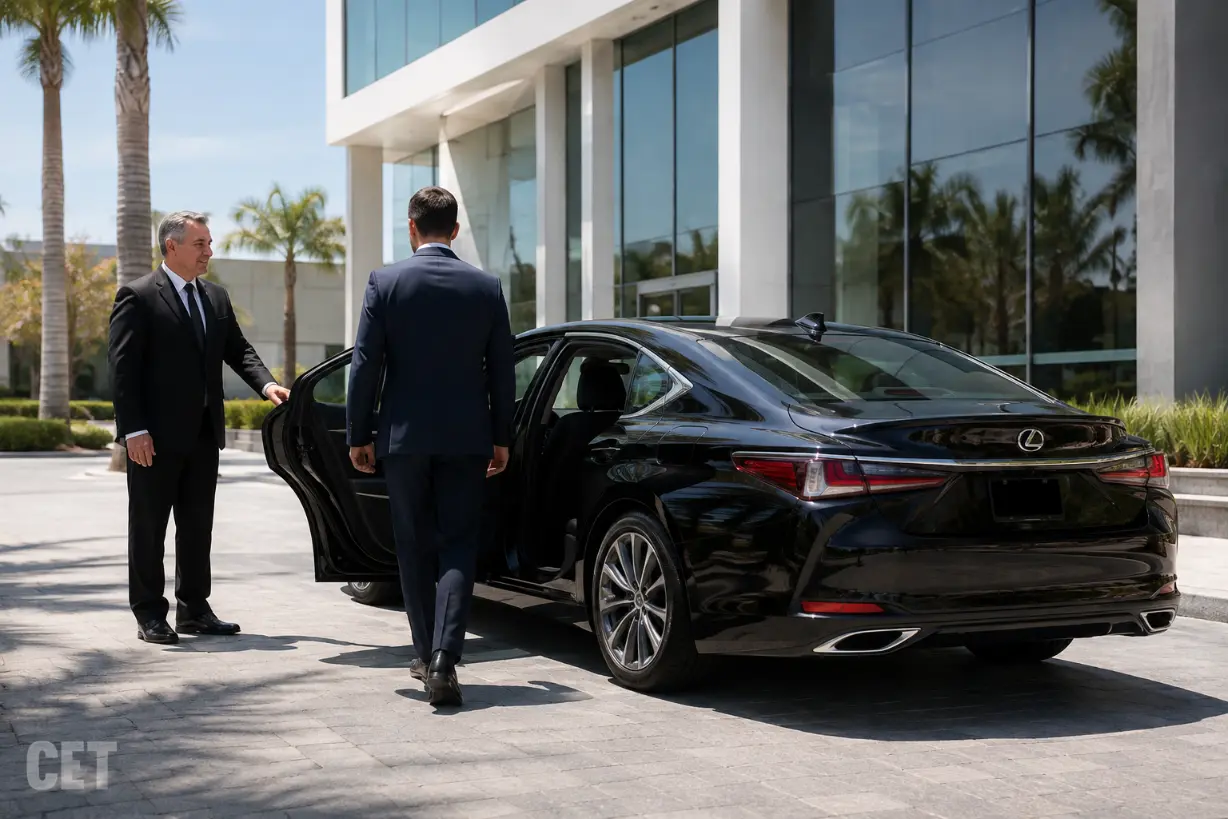
A sedan can be a practical roadshow vehicle for one executive or a small party with modest luggage requirements.
It may fit itineraries involving:
- Investor meetings
- Individual client visits
- Airport-to-meeting transportation
- Executive roadshows
- Business dinners
- Hotel transfers
CET also provides information about premium sedan chauffeur service for individual executive and business travel.
Cadillac Escalade SUV
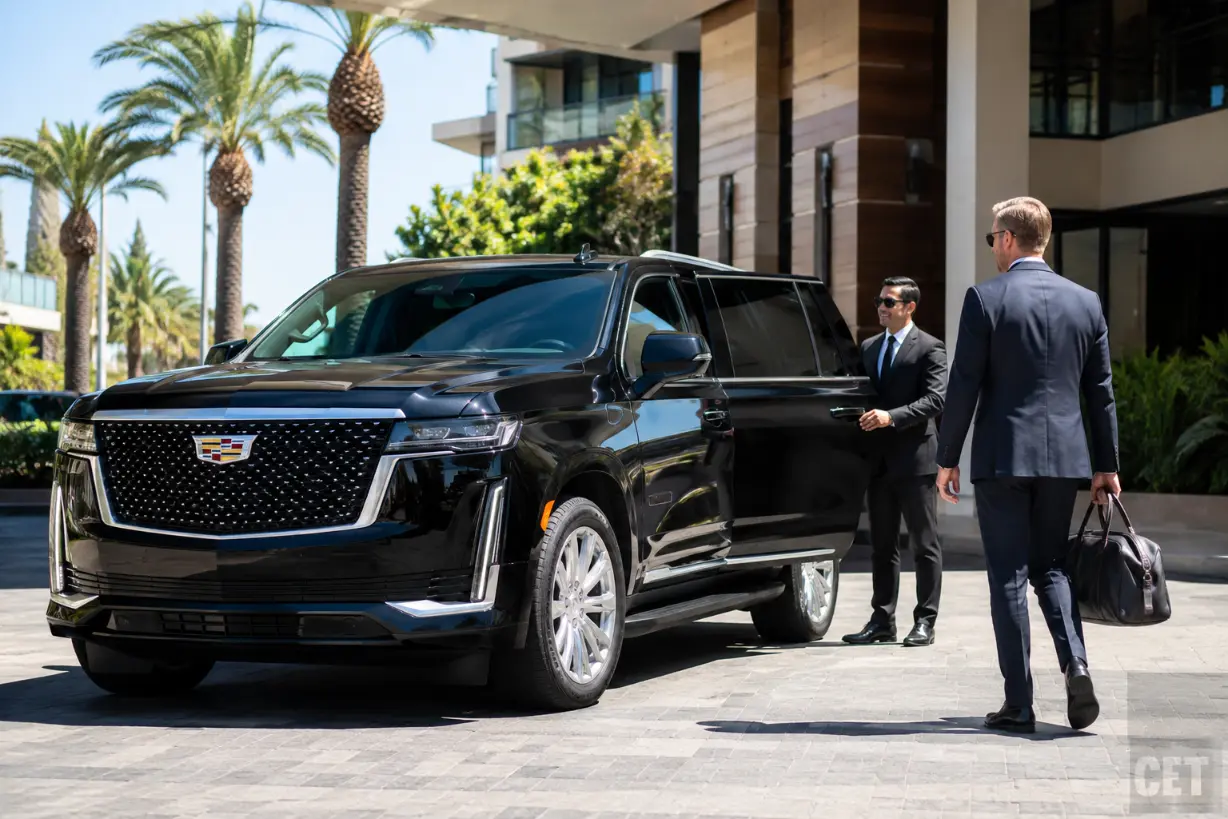
An SUV may be more appropriate when an executive has additional colleagues, checked luggage, presentation materials, or other space requirements.
CET’s fleet includes a Cadillac Escalade ESV for suitable executive and business transportation itineraries.
Mercedes-Benz Sprinter for a Corporate Team
A roadshow does not always involve one executive.
A management team, sales group, advisors, consultants, investor-relations staff, or client group may need to follow the same schedule.
When several business travelers need to move together, an executive van can reduce the coordination required between separate vehicles.
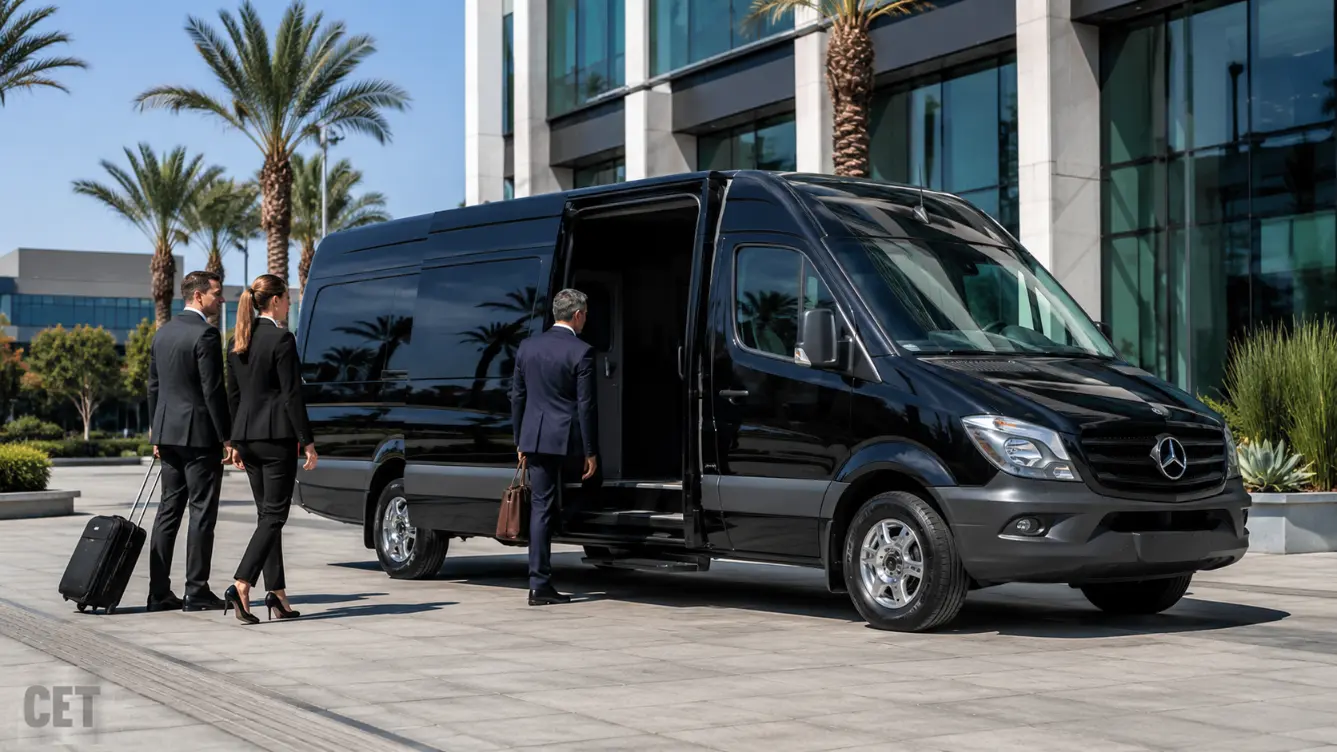
CET’s fleet includes a 10-passenger Mercedes-Benz Sprinter Executive Limousine for appropriate corporate group transportation requirements.

Individual Executive Roadshow vs Corporate Group Roadshow
The transportation plan should reflect whether the roadshow centers on one decision-maker or an entire business team.
| Consideration | Individual Executive | Corporate Group |
|---|---|---|
| Passenger count | One executive or small party | Several colleagues or clients |
| Vehicle | Sedan or SUV may be suitable | SUV, Sprinter, or larger vehicle may be considered |
| Schedule | Usually centered on one executive’s meetings | May involve shared and separate appointments |
| Communication | Executive plus assistant or coordinator | May require group manifests or multiple traveler contacts |
| Luggage | Generally easier to estimate | Can significantly affect practical vehicle capacity |
Do not automatically keep every member of a corporate group in the same vehicle throughout the entire roadshow.
If one executive has a separate afternoon appointment or needs to depart for an airport earlier than the rest of the team, a second vehicle may be more practical.
Conversely, if everyone has the same schedule, keeping the group together can simplify arrival coordination and itinerary updates.
Planning a Multi-Day Corporate Roadshow
Some roadshows extend across two or more days.
A multi-day itinerary requires additional planning because transportation must connect not only the meetings but also hotels, evening events, and the next morning’s schedule.
Day One Example
- Airport arrival
- First client meeting
- Second business appointment
- Hotel check-in
- Client dinner
- Hotel return
Day Two Example
- Hotel pickup
- Breakfast meeting
- Regional office visit
- Investor presentation
- Business lunch
- Final meeting
- Airport departure
When several destinations are involved over multiple days, CET’s destination transportation can be considered as part of the wider business travel plan.
Confirm Overnight Changes
At the end of each roadshow day, verify whether anything has changed for the next morning.
Check:
- First pickup time
- Hotel location
- Passenger count
- Meeting changes
- Added or cancelled appointments
- Airport changes
- Vehicle requirements
A schedule that was correct three days before travel may no longer reflect the actual business plan by the second morning of the roadshow.
Managing Schedule Changes During a Corporate Roadshow
Roadshows are especially vulnerable to schedule changes because each appointment is connected to the next.
Common changes include:
- A meeting starts late
- A meeting runs longer than planned
- A client cancels
- A new meeting is added
- A lunch location changes
- An executive needs to return to the hotel
- A passenger joins or leaves the group
- A flight changes
When the schedule changes, do not simply update the executive’s calendar and assume the transportation plan has also changed.
Use a deliberate process:
- Update the master roadshow itinerary.
- Identify every transportation segment affected.
- Communicate the change to the transportation provider.
- Determine whether pickup times need to change.
- Check whether the route has changed.
- Confirm whether the vehicle requirement is still appropriate.
- Review all later appointments for additional effects.
Roadshow Planning Rule: Every schedule change should be evaluated for its effect on the remainder of the day. A thirty-minute meeting extension can affect much more than the next pickup when several cities and appointments are involved.
Corporate Roadshow Planning for Executive Assistants
Executive assistants and corporate travel coordinators often manage roadshow transportation even though they are not traveling with the executive.
That creates an important communication responsibility.
The Executive Assistant Needs the Complete Picture
The assistant should retain:
- Complete roadshow itinerary
- Passenger information
- Flight details
- Vehicle information
- Hotel details
- Meeting locations
- Reservation information
- Schedule changes
The Executive Needs the Essential Travel Information
The traveler may only need:
- Pickup time
- Pickup location
- Next destination
- Relevant transportation contact information
This allows the assistant to manage the administrative side without making the executive personally handle every logistical detail.
For a broader booking workflow, CET’s guide to booking corporate transportation for executives in Ontario CA covers the information to prepare before submitting a reservation.
The private car hire for executives guide also explains when dedicated chauffeured transportation can make sense for a business traveler.
Corporate Roadshows for Clients, Investors and VIP Guests
The executive traveling on the roadshow is not always an employee of the company arranging transportation.
A business may need transportation for:
- Investors
- Board members
- Prospective clients
- Consultants
- Business partners
- Visiting executives
- Speakers
- Financial professionals
In these situations, transportation becomes part of the guest experience.
A visiting investor may arrive at an airport, attend several company presentations, visit facilities, meet leadership, attend dinner, stay overnight, and depart the next day.
Prearranging those movements allows the host organization to provide a more organized itinerary.
For smaller VIP parties using sedans or SUVs, CET’s black car service in Ontario CA is another relevant transportation option.
Roadshow Transportation for Conferences and Corporate Events
A corporate roadshow can also be built around a major meeting or conference.
An executive might:
- Arrive at an airport
- Meet a customer before the conference
- Travel to a convention center
- Attend an afternoon session
- Meet another client afterward
- Attend a corporate dinner
- Return to a hotel
For trips connected to convention centers, meeting facilities, and other event locations, CET also provides venue transportation.
The event should be included in the roadshow itinerary with a clear required arrival time instead of being treated as an isolated appointment.
When a Dedicated Chauffeur Makes Sense for a Roadshow
A multi-stop business day may require more continuity than a collection of separate transportation reservations.
Roadshows involving closely spaced meetings, repeated stops, and schedule changes may benefit from discussing a more dedicated transportation arrangement with the provider.
CET’s chauffeur service information includes multi-stop travel days and full-day executive itineraries among its business-use cases.
Companies can review CET’s Southern California chauffeur service when comparing options for a complex executive schedule.
The appropriate structure depends on the actual itinerary, so provide the roadshow schedule before deciding which booking format is best.
Common Corporate Roadshow Transportation Mistakes
1. Planning Each Ride Separately
If the entire roadshow schedule is known, treat it as one itinerary rather than waiting until each meeting ends to think about the next transportation segment.
2. Providing Meeting Times Instead of Required Arrival Times
The vehicle schedule should reflect when the executive needs to reach the destination.
3. Creating Back-to-Back Meetings With Unrealistic Travel Windows
Different Southern California cities can involve significant travel, especially when traffic conditions change.
4. Forgetting Airport Requirements
An airport departure should be planned around the traveler’s required airport arrival, not simply the scheduled takeoff time.
5. Choosing the Vehicle Before Confirming Passengers and Luggage
A sedan, SUV, and Sprinter solve different transportation requirements.
6. Assuming the Same Vehicle Setup Works for Every Day
A solo executive on day one may be joined by several colleagues on day two.
7. Leaving Meal and Event Transportation Out of the Schedule
Roadshows often continue beyond office meetings.
8. Failing to Communicate Schedule Changes
Updating a calendar does not automatically update the transportation reservation.
9. Building the Itinerary With No Buffer
A small delay can affect the rest of a multi-city schedule.
10. Backtracking Across Southern California Unnecessarily
When meeting times are flexible, review the geographic order of destinations before finalizing the itinerary.
Corporate Roadshow Transportation Planning Checklist
Use this checklist before finalizing corporate roadshow transportation in Southern California.
- ☐ Executive or passenger name confirmed
- ☐ Passenger mobile contact available
- ☐ Roadshow dates confirmed
- ☐ Every meeting location listed
- ☐ Complete addresses confirmed
- ☐ Required arrival times confirmed
- ☐ Meeting start times recorded separately
- ☐ Expected meeting durations considered
- ☐ Geographic order of destinations reviewed
- ☐ Reasonable travel allowances included
- ☐ Airport details included when applicable
- ☐ Airline and flight numbers provided
- ☐ Hotel transportation included
- ☐ Lunch and dinner transportation included
- ☐ Passenger count finalized
- ☐ Luggage requirements estimated
- ☐ Business materials or equipment considered
- ☐ Sedan, SUV, Sprinter, or other vehicle requirements discussed
- ☐ Corporate group movements coordinated
- ☐ Return or final airport transportation included
- ☐ Master itinerary shared with the appropriate coordinator
- ☐ Final schedule reviewed before travel begins
Turn a Multi-City Schedule Into One Coordinated Executive Itinerary
A successful corporate roadshow is not measured by how many individual rides were booked.
The real objective is to move the executive through a demanding business schedule with as little transportation friction as practical.
That requires understanding how every part of the day connects:
- Airport arrival
- Hotel
- First meeting
- Client visits
- Investor presentations
- Business lunches
- Regional travel
- Corporate events
- Client dinners
- Return transportation
- Airport departure
For a single traveler, a professional sedan may provide the appropriate setup. An executive traveling with colleagues and luggage may benefit from an SUV. A larger business team following the same roadshow may be better suited to an executive Sprinter.
Vehicle selection matters, but the itinerary comes first.
Companies planning corporate roadshow transportation Southern California should provide the complete schedule so the transportation can be built around the meetings, passengers, destinations, and timing requirements that actually define the trip.
Plan Your Southern California Corporate Roadshow With CET
Have your cities, meeting locations, required arrival times, airport details, passenger count, luggage, hotel, and additional stops ready? Send CET the complete itinerary so your executive transportation can be planned around the roadshow.
Frequently Asked Questions About Corporate Roadshow Transportation
What is corporate roadshow transportation?
Corporate roadshow transportation is prearranged executive transportation built around a business itinerary with multiple destinations. It may include airports, hotels, investor meetings, client appointments, corporate offices, site visits, meals, events, and return transportation across one or several cities.
How should a Southern California corporate roadshow be planned?
Start with a master itinerary showing every destination in chronological order. Include pickup times, complete addresses, required arrival times, meeting times, expected meeting durations, airport information, passenger count, luggage, hotels, and the final destination. Review the geographic order of meetings and allow reasonable flexibility between appointments.
What vehicle is best for an executive roadshow?
The appropriate vehicle depends on the number of travelers, luggage, business materials, itinerary, and group requirements. A sedan may fit an individual executive, an SUV can provide additional room, and a Sprinter or executive van may be appropriate when several business travelers need to follow the same schedule.
Can a corporate roadshow include several Southern California cities?
Yes. A roadshow may involve business destinations across Ontario, Riverside, the Inland Empire, Orange County, Los Angeles, and other Southern California markets. The itinerary should account for the geographic order of appointments and realistic travel requirements between cities.
Can airport transportation be included in an executive roadshow?
Yes. Airport arrival or departure can be incorporated into the roadshow itinerary. Provide the airline, flight number, airport, travel date, passenger information, luggage estimate, and information about the first meeting after arrival or final appointment before departure.
Should each roadshow stop be booked as a separate ride?
Not necessarily. The best booking structure depends on the schedule. Some itineraries work well with individual point-to-point transfers, while closely spaced multi-stop roadshows may benefit from discussing a more continuous chauffeured arrangement. Providing the complete itinerary allows the transportation provider to understand the trip before recommending a structure.
How should schedule changes be handled during a corporate roadshow?
Update the master itinerary first, identify every transportation segment affected by the change, communicate the revised information directly to the transportation provider, and review later appointments for additional effects. A delayed meeting early in the day can affect several later transportation segments.
How far in advance should corporate roadshow transportation be arranged?
Arrange transportation once the business itinerary becomes reasonably firm. Earlier planning is particularly useful for multi-city schedules, specific vehicle requirements, airport transfers, large corporate groups, conferences, and roadshows involving several important appointments. Continue updating the transportation plan if the business schedule changes before the travel date.

Sorry, the comment form is closed at this time.