



08 Sep Hourly Executive Car Service for Multi-Stop Business Travel
Quick Answer: Hourly executive car service can make sense when a business traveler has several meetings, uncertain appointment durations, changing pickup times, client visits, airport transfers, or multiple destinations within the same day. Instead of arranging an entirely separate vehicle movement for every stop, an hourly or dedicated chauffeur arrangement can provide greater continuity around a multi-stop business itinerary. The right structure depends on the schedule, vehicle, passenger count, expected duration, and how much flexibility the traveler needs.
Key Takeaways
- Hourly executive car service is most useful when a business itinerary includes multiple stops, uncertain meeting durations, or schedule changes.
- Point-to-point transportation can still be the better option for simple trips with clearly defined pickup and destination times.
- Executive assistants should provide the complete itinerary before deciding whether hourly or point-to-point service fits the trip.
- A sedan may be appropriate for an individual executive, while an SUV can provide additional passenger and luggage space.
- Roadshows, client visits, conferences, corporate events, airport-to-meeting schedules, and full business days are common multi-stop transportation scenarios.
- Hourly service should be evaluated based on the actual itinerary, service minimums, vehicle requirements, waiting time, and total transportation needs rather than assumed to be cheaper or more expensive.
Some business trips are easy to arrange. The traveler leaves a hotel, attends one meeting, and returns later in the day.
Other executive schedules look very different.
A traveler may begin with an airport pickup, visit a corporate office, attend two client meetings, stop for lunch, continue to a conference, meet another executive for dinner, and finish at a hotel.
When the day includes that many moving parts, arranging every segment independently may become unnecessarily complicated.
Hourly executive car service provides another way to structure multi-stop business transportation. Instead of thinking only in terms of one pickup and one destination, companies can discuss an itinerary where chauffeured transportation supports several movements during a defined period.
Corporate Executive Transportation provides corporate executive transportation for executives, business travelers, visiting clients, roadshows, conferences, airport transfers, and other professional travel throughout Southern California.
Table of Contents
- What Is Hourly Executive Car Service?
- Hourly vs Point-to-Point Executive Transportation
- When Does Hourly Executive Transportation Make Sense?
- How Multi-Stop Business Travel Works
- Why Schedule Flexibility Matters
- Airport Transfers With a Multi-Stop Business Day
- Hourly Transportation for Corporate Roadshows
- Sedan vs SUV for Hourly Executive Service
- Client and VIP Transportation
- Planning Hourly Service as an Executive Assistant
- What Affects Hourly Executive Car Service Cost?
- Choosing a Professional Transportation Provider
- Common Multi-Stop Transportation Mistakes
- Hourly Executive Transportation Checklist
- Frequently Asked Questions
What Is Hourly Executive Car Service?
Hourly executive car service is a chauffeured transportation arrangement where a vehicle and chauffeur are reserved for an agreed period rather than treating each transportation movement solely as an independent point-to-point trip.
The exact booking terms vary by provider, vehicle, date, location, and itinerary, so companies should confirm how a particular reservation is structured before booking.
Conceptually, however, hourly service is useful when the traveler needs greater continuity across several transportation movements.
For example, an executive might need transportation for:
- Hotel to corporate office
- Corporate office to client meeting
- Client meeting to business lunch
- Lunch to second client meeting
- Second meeting to conference venue
- Conference to client dinner
- Dinner to hotel
Instead of viewing those as seven unrelated decisions, the itinerary can be evaluated as one multi-stop business day.
CET’s existing corporate transportation guidance also distinguishes between point-to-point trips and hourly arrangements, noting that multi-stop and more open-ended business days can be situations where hourly service deserves consideration.
Hourly Executive Car Service vs Point-to-Point Transportation
Neither booking structure is automatically better.
They solve different transportation problems.
| Consideration | Hourly Executive Service | Point-to-Point Service |
|---|---|---|
| Typical itinerary | Several stops or repeated transportation needs | One defined pickup and destination |
| Schedule flexibility | Useful when appointment durations may vary | Works well when departure times are predictable |
| Multiple meetings | Can support a connected business itinerary | Separate reservations may be needed for different movements |
| Simple airport transfer | May be unnecessary if no later travel is required | Often a natural fit for airport-to-hotel or airport-to-office trips |
| Roadshows | Can be useful for closely scheduled multi-stop itineraries | May work if each transportation segment is clearly separated |
| Vehicle continuity | Can provide continuity during the reserved service period, subject to booking terms | Transportation is structured around each individual trip |
If an executive needs a single transfer from Ontario International Airport to a hotel, point-to-point transportation may be completely appropriate.
If that same executive needs to leave the airport, visit three customers, attend a lunch meeting, and finish at a conference venue, discussing hourly service can make more sense.
When Does Hourly Executive Car Service Make Sense?
The strongest use cases usually involve either multiple destinations or uncertain timing.
1. Multiple Business Meetings in One Day
A day involving several offices, clients, restaurants, hotels, or venues can require repeated transportation.
An hourly arrangement can allow the transportation plan to follow the wider business itinerary rather than requiring the traveler to think about a completely new transportation booking after every appointment.
2. Meeting Durations Are Uncertain
Executives do not always know exactly when a meeting will end.
A scheduled 60-minute client meeting could finish after 40 minutes or continue considerably longer if negotiations, presentations, or discussions require more time.
This uncertainty can make tightly scheduled individual pickups harder to coordinate.
3. The Executive Has Several Client Visits
Sales leaders, consultants, executives, investors, real estate professionals, financial teams, and corporate leadership may need to visit several business locations in succession.
4. The Traveler Is Attending a Conference or Event
A conference day may involve transportation from the hotel to the event, then to an off-site meeting, client dinner, networking function, and finally back to the hotel.
5. The Trip Is Part of a Corporate Roadshow
Roadshows often contain several meetings and changing departure times, making them one of the clearest examples of a multi-stop transportation itinerary.
6. A Client or VIP Guest Is Being Hosted
Companies may prefer to organize one coordinated transportation plan for an important visitor rather than requiring the guest to arrange transportation repeatedly throughout the visit.
7. The Executive Needs Transportation Throughout Part of the Day
Some schedules contain a concentrated block of business appointments followed by several hours with no further travel requirement. In these cases, a company can discuss whether hourly transportation during that active portion of the itinerary is appropriate.
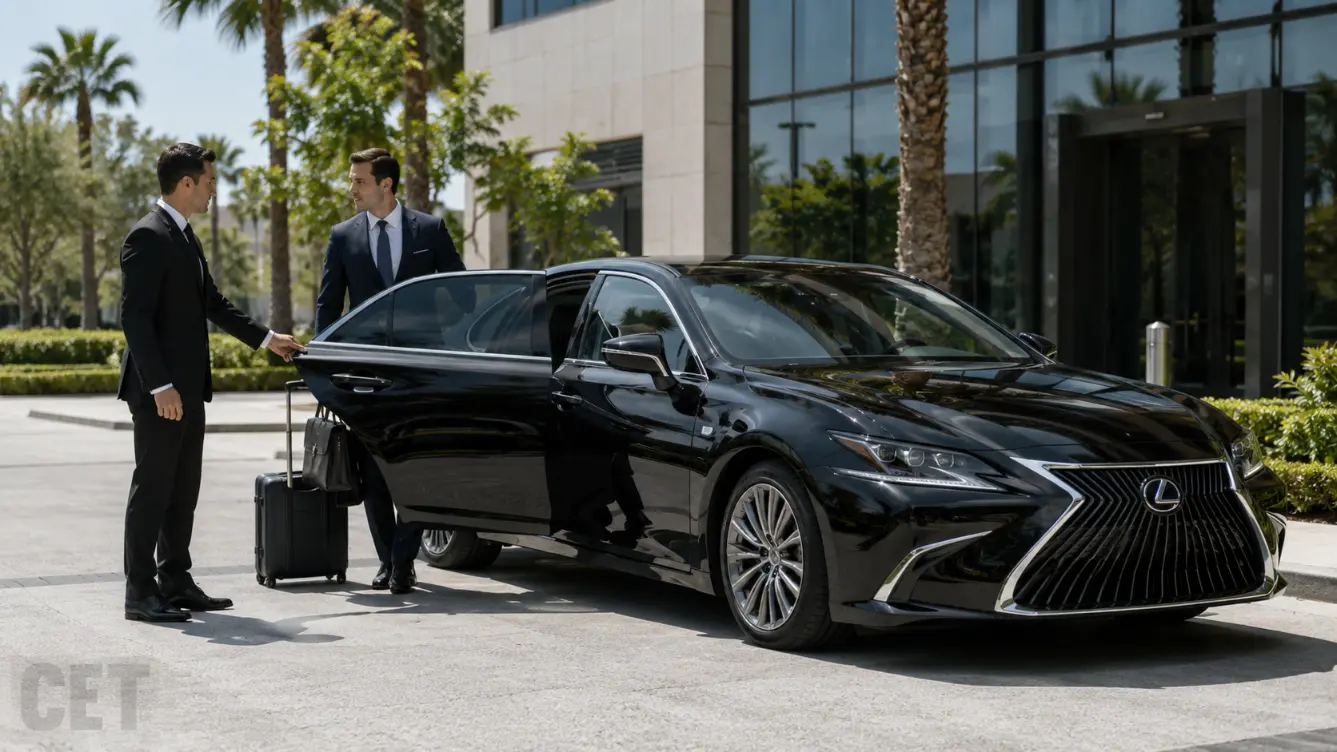
How to Plan a Multi-Stop Business Travel Day
Before requesting hourly executive service, build the complete transportation itinerary.
Do not simply say, “We need a car for six hours.”
The provider also needs to understand what is expected during those hours.
A useful itinerary might look like:
| Time | Transportation | Business Requirement |
|---|---|---|
| 7:30 a.m. | Hotel pickup | Executive meeting at 8:15 a.m. |
| 10:00 a.m. | Corporate office to client location | Client presentation begins at 10:45 a.m. |
| 12:15 p.m. | Client location to restaurant | Business lunch reservation |
| 2:00 p.m. | Restaurant to second business meeting | Afternoon executive appointment |
| 4:30 p.m. | Meeting to hotel | End of daytime transportation requirement |
The actual itinerary may change, but preparing it in advance gives the transportation provider useful context.
Pro Tip: Provide both the meeting start time and the required destination arrival time. If a presentation begins at 10:00 a.m., the executive may need to arrive at 9:40 a.m. for building access, preparation, or a pre-meeting conversation. Transportation should be built around the required arrival time rather than the meeting start time alone.
Why Schedule Flexibility Matters for Executive Travel
Multi-stop business days rarely unfold with perfect precision.
Common changes include:
- A client meeting ends early
- A negotiation runs longer than expected
- A lunch location changes
- An unscheduled customer visit is added
- An executive needs to return to the hotel
- A conference session moves
- A business dinner begins later
- An airport departure changes
Hourly transportation can be worth considering when these types of changes are reasonably possible.
However, “hourly” should not be interpreted as unlimited transportation without terms or geographic boundaries. The company should still provide the expected itinerary and confirm service conditions when booking.
Southern California Traffic Adds Another Variable
Business itineraries across Ontario, Riverside, Orange County, Los Angeles, and other Southern California markets may encounter changing traffic conditions throughout the day.
California travelers and corporate coordinators can review the official Caltrans QuickMap for current traffic, CHP incidents, highway information, lane closures, and related roadway conditions.
A realistic business itinerary should leave enough flexibility that one traffic delay or extended meeting does not automatically disrupt every later appointment.
Combining Airport Transportation With a Multi-Stop Business Day
An airport arrival can be the beginning of a full executive schedule rather than the final destination.
For example:
- Ontario International Airport pickup
- Corporate office
- Client lunch
- Regional meeting
- Hotel
- Business dinner
In this scenario, the company can discuss whether it makes more sense to book a single airport transfer followed by later point-to-point reservations or to arrange a more continuous transportation structure for part of the day.
CET’s airport transportation service can be incorporated into wider corporate travel involving meetings, hotels, events, and other business destinations.
Provide Complete Flight Information
When an airport is involved, provide:
- Passenger name
- Mobile number
- Airline
- Flight number
- Travel date
- Arrival airport
- Passenger count
- Luggage estimate
- First business destination
- Required arrival time at the first meeting
Travel coordinators using Ontario International Airport can also review the airport’s official ground transportation information when preparing an ONT arrival or departure.
Hourly Executive Car Service for Corporate Roadshows
Corporate roadshows are one of the strongest reasons to consider a more flexible transportation structure.
A roadshow may move an executive among several locations and cities during the same day.
Common examples include:
- Investor presentations
- Regional sales visits
- Client meetings
- Real estate tours
- Site inspections
- Corporate leadership visits
- Financial meetings
- Media appearances
- Recruiting schedules
The exact end time of each stop may be difficult to predict before the day begins.
For a detailed planning framework, CET’s guide to corporate roadshow transportation in Southern California covers multi-city route planning, required arrival times, airports, vehicle selection, and schedule changes.
Roadshow Example
An executive could have:
- Morning hotel pickup in Ontario
- First meeting in Riverside
- Lunch in Orange County
- Afternoon client presentation in Irvine
- Evening meeting in Los Angeles
- Final hotel transfer
If every meeting has a fixed ending time with long gaps between appointments, separate transfers may work well.
If the meetings are close together and likely to run long or finish early, discussing hourly service may provide more practical continuity.
Sedan vs SUV for Hourly Executive Car Service
Vehicle selection should follow the itinerary.
Do not automatically reserve an SUV because the traveler is a senior executive, and do not automatically choose a sedan because only one passenger is listed.
Consider:
- Passenger count
- Luggage
- Presentation materials
- Length of the business day
- Airport requirements
- Client or guest transportation
- Number of planned stops
Executive Sedan
A sedan can be a practical choice for one executive or a small party with modest luggage.
It may suit:
- Individual business meetings
- Multi-stop corporate travel
- Airport-to-meeting itineraries
- Client appointments
- Executive roadshows
- Business dinners
CET’s premium sedan chauffeur service information provides additional context for individual executive transportation.

Luxury SUV
An SUV may be a better fit when the traveler has:
- Additional passengers
- Several checked bags
- Presentation equipment
- Business materials
- Client guests
- Additional space requirements
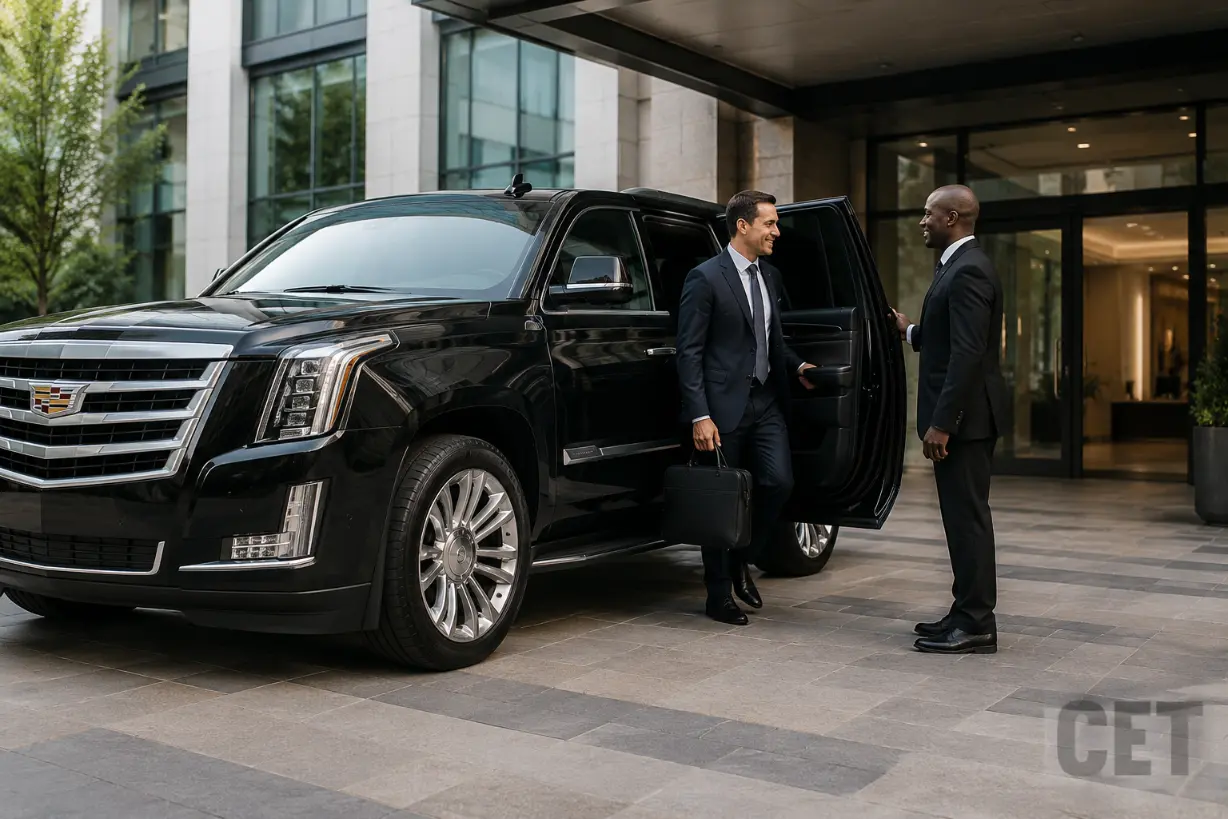
CET’s fleet includes a Cadillac Escalade ESV for suitable executive and business transportation requirements.
What If Several Business Travelers Need Hourly Transportation?
Hourly or dedicated chauffeured transportation is not limited to an individual executive.
A corporate team may also have a full-day itinerary involving:
- Hotel pickup
- Conference transportation
- Off-site client meeting
- Team lunch
- Corporate event
- Business dinner
- Hotel return
When several travelers follow the same schedule, keeping the group together can simplify coordination.
CET’s fleet includes a 10-passenger Mercedes-Benz Sprinter Executive Limousine that lists dedicated chauffeur service, executive transportation, and corporate shuttling among its service uses.
If different executives have separate afternoon schedules, however, multiple vehicles may still be the more practical arrangement.
The group transportation plan should follow the itinerary rather than forcing every passenger into the same schedule.
Hourly Executive Transportation for Clients and VIP Guests
Companies also use professional transportation when hosting people from outside the organization.
A visiting guest could be:
- A board member
- An investor
- A prospective customer
- A consultant
- A business partner
- A speaker
- A candidate
- A visiting executive
A guest itinerary might include:
- Airport pickup
- Hotel
- Corporate headquarters
- Facility tour
- Business lunch
- Second meeting
- Client dinner
- Return to hotel
For this type of itinerary, the host company can discuss whether hourly transportation would make the day easier to coordinate than arranging every movement independently.
CET’s black car service in Ontario CA is also relevant for executive sedan and SUV transportation involving corporate guests and VIP travelers.
Planning Hourly Executive Service as an Executive Assistant
Executive assistants should not begin with the question, “How many hours should I book?”
Begin with the itinerary.
Once the transportation requirements are visible, the provider can better explain whether hourly service, individual transfers, or another booking structure fits the day.
Build a Master Itinerary
Include:
- Passenger name
- Passenger contact information
- Travel date
- Initial pickup time
- Every known destination
- Required arrival times
- Meeting start times
- Expected meeting durations
- Airport information
- Passenger count
- Luggage
- Hotel information
- Final destination
CET’s Executive Assistant’s Guide to Arranging Corporate Transportation provides a broader framework for coordinating the executive, transportation provider, flight information, meetings, vehicles, and schedule changes.
Ask Which Booking Structure Fits the Day
Do not assume that an itinerary with three stops automatically requires hourly service.
If those three appointments are spread across twelve hours with long periods where transportation is not needed, separate point-to-point trips may be more practical.
Conversely, five closely spaced stops within a six-hour business period may be worth evaluating as an hourly or dedicated chauffeur arrangement.
What Affects the Cost of Hourly Executive Car Service?
There is no universal hourly price that applies to every executive transportation itinerary.
Pricing can depend on factors such as:
- Vehicle type
- Length of the reservation
- Service minimums
- Travel date
- Pickup location
- Geographic area
- Number of stops
- Waiting time
- Airport or venue requirements
- Tolls or parking where applicable
- Special itinerary requirements
Because the structure varies, companies should provide the complete itinerary and request pricing for the actual trip.
Compare Hourly Service With Multiple Individual Transfers
If the executive has several stops, compare:
- The cost of separate point-to-point reservations
- The cost of the proposed hourly arrangement
- The amount of schedule flexibility required
- The likelihood that meetings will change
- The value of transportation continuity
The cheapest structure on paper is not automatically the best structure for a high-value business day.
Likewise, hourly transportation should not be selected simply because it sounds more convenient.
The itinerary should justify the service.
Hourly Car Service vs Rental Car for a Multi-Stop Business Day
Some companies may also compare hourly chauffeured transportation with renting a vehicle.
With a rental car, the executive controls the vehicle but also handles:
- Driving
- Navigation
- Parking
- Fuel
- Rental pickup
- Rental return
With hourly executive service, the traveler remains a passenger while a professional chauffeur handles the driving portion of the itinerary.
Neither structure is automatically correct for every trip.
CET’s corporate car service vs rental car guide provides a broader comparison for Southern California business travelers deciding between those two transportation formats.
Hourly Service vs Several On-Demand Rides
On-demand transportation can work well for flexible personal and business trips.
However, a high-value executive itinerary may require more advance planning.
Consider an executive who has:
- An 8:00 a.m. board meeting
- A 10:30 a.m. client presentation
- A noon lunch
- A 2:00 p.m. facility tour
- A 4:30 p.m. investor meeting
Requesting each ride only after the preceding meeting ends creates repeated transportation decisions throughout the day.
Prearranged hourly service can reduce those repeated decisions when the itinerary is known in advance.
The benefit is primarily planning and continuity rather than the assumption that every trip requires premium transportation.
Choosing a Professional Hourly Executive Transportation Provider
Companies should evaluate more than vehicle photographs when arranging transportation for executives or corporate guests.
Useful questions include:
- Does the provider offer an appropriate vehicle?
- Can the itinerary include multiple stops?
- Can airport transportation be incorporated into the same travel plan?
- How are schedule changes communicated?
- Are there hourly minimums?
- What charges can apply beyond the quoted time?
- How is overtime handled if the trip runs longer?
- Does the provider handle individual executive and group transportation?
- Does the provider meet applicable California operating requirements?
Understand California Passenger Transportation Rules
The California Public Utilities Commission Passenger Carrier FAQs explain that charter-party transportation is prearranged for the exclusive use of an individual or group and that charges can be based on mileage, time of use, or a combination of both.
The CPUC also maintains resources for reviewing charter-party carrier operating authority and licensing requirements.
For companies arranging transportation for executives, employees, and important guests, checking applicable operating credentials can be part of the vendor-selection process.
Common Mistakes When Booking Multi-Stop Executive Transportation
1. Booking Hours Without Providing the Itinerary
The number of hours alone does not explain where the traveler needs to go or what the transportation day involves.
2. Assuming Hourly Service Is Always Better for Multiple Stops
Three stops spread over an entire day may be better handled differently than six closely spaced meetings.
3. Using Meeting Start Times as Pickup Times
Transportation should be planned around when the executive needs to arrive.
4. Forgetting Meeting Overruns
A tightly packed itinerary should include some flexibility for appointments that last longer than expected.
5. Leaving Airports Out of the Main Itinerary
If the day begins or ends at an airport, include that segment from the start.
6. Choosing the Vehicle Before Confirming Luggage
An individual executive may still need an SUV if several bags or business materials are involved.
7. Assuming Every Passenger Has the Same Schedule
A corporate team may split into different meetings during the day.
8. Failing to Communicate Schedule Changes
Updating a calendar invitation does not automatically update the transportation reservation.
9. Ignoring Service Minimums and Overtime Terms
Ask how the hourly reservation is structured before confirming the trip.
10. Building an Unrealistic Southern California Schedule
Meetings in different cities need appropriate travel time between them.
Hourly Executive Car Service Booking Checklist
Use this checklist before requesting hourly executive car service for a multi-stop business itinerary.
- ☐ Travel date confirmed
- ☐ Passenger name confirmed
- ☐ Passenger contact information available
- ☐ Initial pickup time confirmed
- ☐ Pickup address verified
- ☐ Every known destination listed
- ☐ Required arrival times recorded
- ☐ Meeting start times recorded separately
- ☐ Expected meeting durations estimated
- ☐ Passenger count finalized
- ☐ Luggage requirements estimated
- ☐ Business materials or equipment considered
- ☐ Airport information provided when applicable
- ☐ Flight number and airline provided
- ☐ Hotel transportation included
- ☐ Client lunch or dinner stops included
- ☐ Vehicle type discussed
- ☐ Hourly minimum discussed
- ☐ Overtime or extended-time terms understood
- ☐ Parking or toll considerations discussed where relevant
- ☐ Final destination confirmed
- ☐ Return transportation addressed
- ☐ Process for itinerary changes understood
When Hourly Executive Transportation Is Probably Not Necessary
A useful buyer guide should also identify situations where hourly service may be more than the trip requires.
Consider point-to-point transportation instead when:
- The traveler only needs an airport-to-hotel transfer.
- There is one clearly scheduled meeting.
- Several hours separate transportation requirements.
- The executive does not need a vehicle between appointments.
- The trip has clearly defined pickup and destination times.
In these scenarios, individual transfers may provide a simpler booking structure.
The objective is not to maximize the number of reserved hours.
The objective is to match the transportation structure to the business itinerary.
When Hourly Executive Car Service Becomes Valuable
Hourly executive transportation becomes more compelling as the number of connected transportation requirements increases.
A business traveler moving between an airport, hotel, meeting, client office, restaurant, conference, and evening event is dealing with a fundamentally different itinerary from someone who needs one ride to one meeting.
The strongest use cases tend to share several characteristics:
- Multiple stops
- Closely scheduled meetings
- Uncertain meeting durations
- Important clients or executives
- Regional travel
- Roadshows
- Changing schedules
- A desire for transportation continuity
In those situations, an hourly structure allows the company to think about transportation as part of the entire business day.
For individual travelers, that may mean an executive sedan.
For an executive traveling with colleagues, luggage, or additional materials, an SUV may be more appropriate.
For corporate teams following the same itinerary, a larger executive vehicle may be considered.
The correct solution starts with the schedule.
If the itinerary is still being developed, CET’s guide on how to book corporate transportation for executives explains what information to prepare before requesting service.
Plan Hourly Executive Transportation Around Your Business Day
Have several meetings, client visits, airport transfers, or business stops on the same itinerary? Send CET the travel date, pickup location, passenger count, vehicle requirements, destinations, and expected schedule so the appropriate executive transportation structure can be discussed.
Frequently Asked Questions About Hourly Executive Car Service
What is hourly executive car service?
Hourly executive car service is a chauffeured transportation arrangement where a vehicle and chauffeur are reserved for an agreed period rather than treating every transportation movement only as a separate point-to-point trip. It can be useful for multi-stop business days, roadshows, client visits, events, and schedules where meeting durations may change.
When is hourly car service better than point-to-point transportation?
Hourly service can be more practical when several transportation movements occur within a concentrated period, meeting end times are uncertain, or an executive needs greater continuity between stops. Point-to-point service may be more appropriate for simple transfers or trips with long periods between transportation needs.
Can hourly executive car service handle multiple business stops?
Multi-stop itineraries are one of the primary situations where an hourly arrangement may be considered. Provide all known destinations, required arrival times, expected meeting durations, and the final destination so the transportation provider can understand the complete schedule.
Can hourly executive service include an airport pickup?
Yes, an airport transfer can be part of a broader multi-stop business itinerary. Provide the airline, flight number, passenger information, luggage requirements, first business destination, and any time-sensitive appointment following the flight.
What vehicle should I book for hourly executive transportation?
The vehicle should match the passenger count, luggage, itinerary, and business requirements. A sedan may work well for an individual executive, while an SUV can provide additional passenger and luggage space. Larger executive vehicles may be appropriate when a corporate team follows the same itinerary.
Is hourly executive car service good for corporate roadshows?
It can be. Roadshows often involve multiple meetings, cities, changing appointment durations, and closely connected transportation segments. Whether hourly service or separate point-to-point reservations are more appropriate depends on the exact schedule and should be evaluated using the complete itinerary.
How much does hourly executive car service cost?
Cost varies according to the vehicle, date, duration, service minimums, itinerary, geographic area, waiting time, stops, parking or toll requirements where applicable, and other reservation details. Request pricing using the actual business itinerary rather than assuming one standard hourly rate applies to every trip.
What information should I provide when booking hourly executive transportation?
Provide the travel date, passenger name and contact information, pickup time and address, all known destinations, required arrival times, expected meeting durations, passenger count, luggage, flight information when applicable, vehicle requirements, and final destination. Also ask about service minimums, schedule changes, and extended-time terms before confirming the reservation.

Sorry, the comment form is closed at this time.