



31 Aug Executive Assistant’s Guide to Arranging Corporate Transportation
Quick Answer: An executive assistant arranging corporate transportation should start with the complete business itinerary before selecting a vehicle. Confirm the traveler, pickup times, required arrival times, flight details, passenger count, luggage, meeting addresses, additional stops, return transportation, and any schedule constraints. Then choose a sedan, SUV, or executive van that fits the actual trip. The goal is to make transportation work around the executive’s schedule without requiring the traveler to manage logistics throughout the day.
Key Takeaways for Executive Assistants
- Build the complete itinerary before deciding which vehicle to reserve.
- Separate vehicle pickup time, required destination arrival time, and the actual meeting start time.
- Provide flight information, passenger contact details, luggage requirements, and all known business stops.
- Choose a sedan, SUV, or executive van according to passenger count, baggage, business purpose, and itinerary.
- Keep one master transportation itinerary so changes are easier to communicate.
- Give the executive the essential pickup information while retaining the detailed reservation information needed to manage the trip.
- Review transportation again whenever a flight, meeting, passenger, hotel, or destination changes.
Executive assistants frequently manage the parts of corporate travel that senior leaders never need to see.
An executive may simply walk out of a terminal, hotel, office, conference, or client meeting and enter the scheduled vehicle. Behind that simple experience, however, an assistant may have coordinated flights, hotels, meetings, client visits, transportation, dinner reservations, event schedules, multiple cities, and several changes to the itinerary.
That is why executive assistant corporate transportation planning should be approached as an itinerary-management responsibility rather than simply booking a car.
A single change can affect the entire transportation schedule. A delayed flight may alter an airport transfer. A meeting that runs long may affect a client appointment. An additional passenger may require a different vehicle. More luggage than expected may make a sedan impractical.
Corporate Executive Transportation provides corporate executive transportation for executives, business travelers, visiting clients, and corporate groups throughout Southern California. For assistants managing these trips, the strongest process is to understand the business day first and build transportation around it.
Table of Contents
- The Executive Assistant’s Role in Transportation Planning
- What to Collect Before Booking
- Build a Master Transportation Itinerary
- Pickup Time vs Meeting Time
- Planning Executive Airport Transportation
- Choosing a Sedan, SUV or Executive Van
- Managing Multi-Stop Business Travel
- Transportation for Clients and VIP Guests
- Coordinating Corporate Groups
- Who Needs Which Transportation Details?
- Managing Schedule Changes
- Evaluating a Corporate Transportation Provider
- Common Executive Assistant Booking Mistakes
- Executive Transportation Checklist
- Frequently Asked Questions
The Executive Assistant’s Role in Corporate Transportation Planning
Corporate transportation usually involves at least three parties:
- The executive or business traveler
- The executive assistant or travel coordinator
- The transportation provider
The executive assistant often connects the other two.
The transportation provider needs accurate operational details. The executive needs clear instructions about when and where transportation will arrive. The assistant needs enough information to manage the entire itinerary and respond when something changes.
That means the assistant’s responsibility extends beyond submitting a reservation.
The assistant may need to coordinate transportation around:
- Airline schedules
- Airport arrivals and departures
- Hotels
- Board meetings
- Executive leadership meetings
- Investor appointments
- Client visits
- Sales presentations
- Site inspections
- Conferences
- Convention centers
- Business lunches
- Client dinners
- Corporate events
- Return airport transportation
When several of those occur during the same trip, transportation should be planned as one connected itinerary rather than unrelated rides.
What an Executive Assistant Should Collect Before Booking Transportation
Collecting the right information before making the reservation reduces unnecessary emails, corrections, and last-minute changes.
A simple point-to-point trip may require only a few details. A full executive visit can require significantly more information.
| Information | What to Confirm | Why It Matters |
|---|---|---|
| Traveler | Full name and mobile contact | Identifies the actual passenger rather than only the person making the reservation. |
| Travel date | Correct day and date | Avoids errors when several days of transportation are involved. |
| Pickup | Requested pickup time and exact address | Establishes where the transportation segment begins. |
| Destination | Full destination address | Reduces confusion when businesses or hotels have multiple locations. |
| Flight | Airline, flight number and airport | Connects the ground transportation itinerary with air travel. |
| Passengers | Final passenger count | Influences vehicle selection. |
| Luggage | Number and approximate size of bags | A vehicle may have enough seats but insufficient practical baggage space. |
| Meetings | Required arrival and start times | Allows transportation timing to be planned separately from appointment timing. |
| Stops | Offices, hotels, restaurants, venues and client locations | Allows the complete business itinerary to be considered. |
If this is one of the assistant’s first executive transportation assignments, CET’s guide to booking corporate transportation for executives provides a step-by-step look at the reservation process.
Build One Master Executive Transportation Itinerary
A master itinerary is one of the most useful tools an executive assistant can create.
Instead of pulling transportation information from multiple calendar appointments, email chains, messages, travel confirmations, and hotel reservations, consolidate the transportation segments into one chronological document.
For example:
| Time | Transportation | Business Requirement |
|---|---|---|
| 7:15 a.m. | Hotel pickup | Executive meeting at 8:15 a.m. |
| 10:00 a.m. | Office to client site | Client meeting at 10:45 a.m. |
| 12:15 p.m. | Client site to restaurant | Business lunch at 12:45 p.m. |
| 2:15 p.m. | Restaurant to conference venue | Session begins at 3:00 p.m. |
| 6:15 p.m. | Venue to hotel | End of daytime program |
Pro Tip: Maintain one master transportation itinerary and update it whenever the executive’s schedule changes. After updating the master version, identify which transportation reservations, passengers, meetings, hotels, or other parties are affected.
Pickup Time, Arrival Time and Meeting Time Are Not the Same
One of the most important distinctions in executive travel planning is the difference between three times:
- Vehicle pickup time
- Required arrival time
- Meeting or event start time
If a board meeting begins at 9:00 a.m., the executive may need to arrive at 8:45 a.m. The vehicle may need to leave the hotel considerably earlier depending on distance, traffic, building access, parking arrangements, security, or other factors.
A calendar invitation containing only the meeting start time is therefore not enough information to plan the transportation correctly.
Account for Southern California Travel Conditions
Southern California traffic can vary substantially by route and time of day. Executive assistants can review the official Caltrans QuickMap for current highway conditions, incidents, lane closures, traffic information, and other travel data when reviewing an itinerary.
The transportation provider handles the actual driving plan, but an assistant should avoid creating a schedule where every meeting assumes the minimum possible travel time.
Planning Executive Airport Transportation
Airport transportation introduces additional variables because the ground itinerary must connect with a flight schedule.
For an executive airport transfer, provide:
- Traveler’s full name
- Mobile number
- Airline
- Flight number
- Travel date
- Arrival or departure airport
- Passenger count
- Luggage estimate
- Next destination
- Any meeting scheduled after arrival
CET’s airport transportation service can be incorporated into a larger executive itinerary when transportation is needed between an airport and an office, hotel, convention center, client site, meeting, or other destination.
Ontario International Airport Arrivals
For travelers arriving through ONT, Ontario International Airport maintains an official ground transportation information page that executive assistants can review while preparing an airport itinerary.
Flight details are especially important because Ontario International Airport uses separate passenger terminal areas. Accurate airline and flight information helps reduce uncertainty around an executive arrival.
Airport Pickup May Be Only the First Trip of the Day
An arriving executive may go directly from the airport to:
- Corporate headquarters
- A client meeting
- A hotel
- A conference
- The Ontario Convention Center
- A facility tour
- A business lunch
If the assistant already knows those later movements, they should be included in the transportation planning process rather than arranged only after the traveler lands.
Choosing a Sedan, SUV or Executive Van
Vehicle selection should come after passenger count, luggage, and itinerary requirements are understood.
Do not start with the assumption that every senior executive requires the largest available vehicle.
The correct choice is the vehicle that supports the actual trip.
Executive Sedan
A sedan may be appropriate for an individual executive or small party with modest luggage requirements.
It can be particularly suitable for:
- Airport transfers
- Hotel transportation
- Executive meetings
- Client appointments
- Business dinners
- Individual corporate travel
For assistants comparing this format, CET’s premium sedan chauffeur service information provides additional context on individual executive and client transportation.

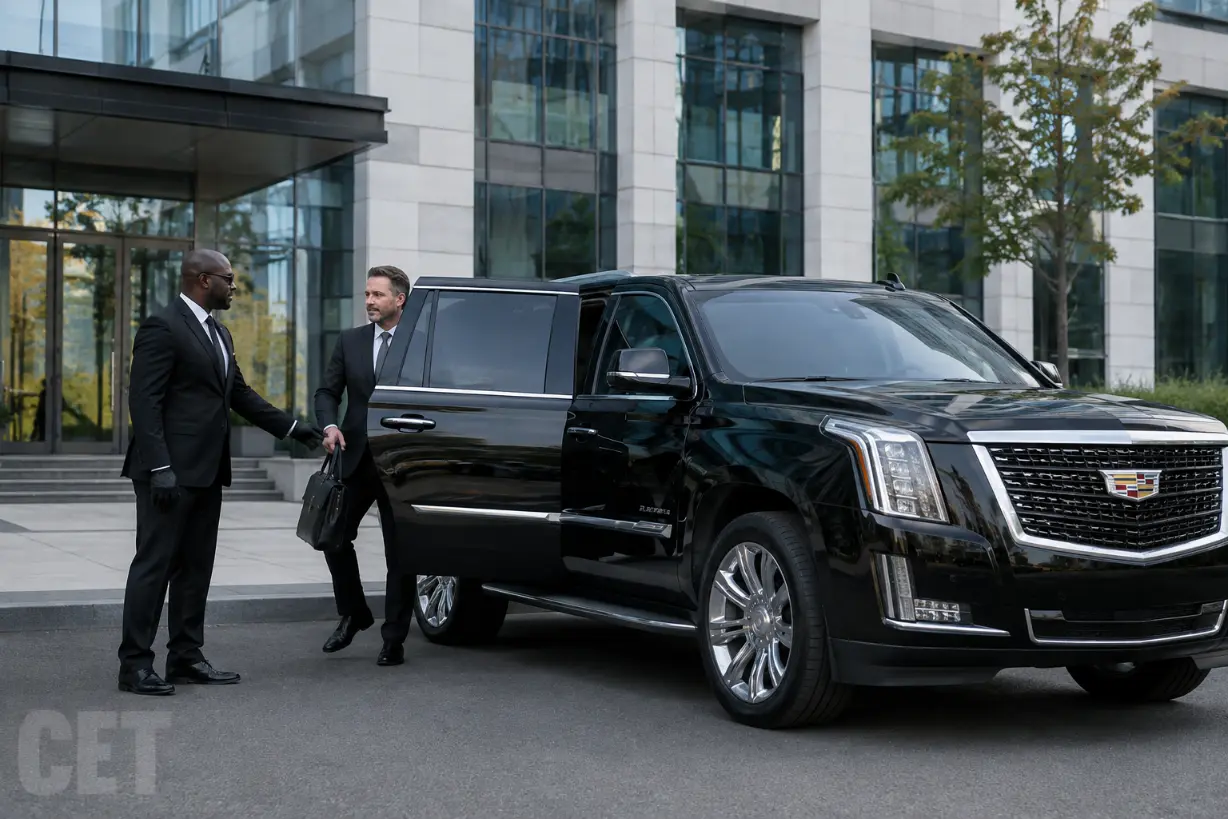
Luxury SUV
An SUV can make more sense when the executive is traveling with additional colleagues, more baggage, presentation materials, or other business equipment.
CET’s fleet includes a Cadillac Escalade ESV for appropriate executive and business transportation requirements.
Passenger capacity should not be considered independently from luggage. This is particularly important for airport trips involving checked bags.
Mercedes Sprinter or Executive Van
When several executives, clients, or colleagues are following the same itinerary, an executive van may simplify the transportation plan.
CET’s fleet includes a 10-passenger Mercedes-Benz Sprinter Executive Limousine for suitable corporate group transportation requirements.
Keeping a team together may reduce the need to coordinate multiple vehicle arrivals, communicate schedule changes to several drivers, or wait for separated travelers at the next destination.

Managing Multi-Stop Executive Business Travel
Multi-stop travel is where executive assistant transportation planning becomes especially valuable.
An executive’s schedule might include:
- Hotel pickup
- Corporate office
- Client meeting
- Business lunch
- Second client appointment
- Conference
- Executive dinner
- Hotel return
When the full schedule is already known, provide it before the trip rather than arranging each transportation segment independently throughout the day.
CET’s destination transportation service may also be relevant for executives moving between several Southern California business destinations.
Determine Whether the Executive Needs Point-to-Point or Continuous Transportation
Some itineraries contain long gaps between appointments and work well as individual transfers.
Other schedules contain several closely spaced meetings where a more continuous transportation arrangement may be more practical.
Instead of deciding based on assumptions, provide the complete itinerary and discuss which transportation format fits the schedule.
Planning an Executive Roadshow
Roadshows create one of the most demanding corporate transportation assignments for an executive assistant.
A single day may involve several cities, offices, clients, investors, hotels, restaurants, or meeting venues.
Common roadshow scenarios include:
- Investor meetings
- Regional sales visits
- Client presentations
- Leadership tours
- Property inspections
- Real estate meetings
- Candidate interviews
- Corporate site visits
The roadshow itinerary should identify:
- Every destination
- Required arrival time
- Expected meeting duration
- Pickup location after the meeting
- Meal reservations
- Hotel stops
- Final airport or return transportation
Leave reasonable flexibility between appointments. A business meeting that runs twenty minutes long should not automatically make the next three appointments late.
Arranging Transportation for Visiting Clients and VIP Guests
Executive assistants are also frequently responsible for transportation involving people outside their own company.
Examples include:
- Board members
- Investors
- Prospective clients
- Business partners
- Consultants
- Speakers
- Job candidates
- Visiting senior executives
For a guest, transportation is part of the overall experience with the host organization.
A visiting client may require:
- Airport pickup
- Hotel transportation
- Office meeting
- Facility tour
- Leadership lunch
- Additional client meeting
- Business dinner
- Return to hotel
- Airport departure
The purpose is not simply to provide an expensive vehicle. The practical objective is to reduce uncertainty and logistical friction during the visit.
For individual executives and VIP travelers, CET’s black car service in Ontario CA provides another sedan and SUV transportation option to consider.
CET’s guide to private car hire for executives also explains situations where prearranged private transportation may make sense for senior travelers and corporate guests.
Coordinating Transportation for a Corporate Group
Arranging one executive sedan and coordinating a group of ten business travelers are different logistical assignments.
For a corporate group, collect:
- Total number of travelers
- Arrival dates and times
- Whether everyone arrives together
- Luggage requirements
- Hotel information
- Conference or meeting schedule
- Whether the group must remain together
- Names of executives traveling separately
- Departure arrangements
Use the Itinerary to Decide Whether the Group Should Stay Together
A larger vehicle can make sense when several colleagues have the same schedule.
For example, if a group needs to travel from a hotel to a convention, then to dinner, and finally back to the hotel, keeping everyone together may simplify timing.
However, if two executives need to leave the conference early for another meeting, separate transportation may be more practical.
The itinerary should drive the transportation plan rather than forcing every traveler into the same arrangement.
Transportation for Conferences and Corporate Events
Corporate events can involve several transportation layers at once:
- Airport arrivals
- Hotel transfers
- Executive transportation
- Speaker transportation
- Conference transfers
- Client dinners
- Evening functions
- Airport departures
CET also provides venue transportation for business meetings, events, and corporate guests.
When several travelers are involved, consider creating a transportation manifest containing:
- Passenger or group name
- Arrival information
- Assigned vehicle
- Hotel
- Meeting or event destination
- Pickup time
- Departure schedule
This makes it easier to identify missing transportation arrangements before the event begins.
Who Needs Which Corporate Transportation Details?
One common mistake is assuming everyone involved needs every piece of information.
They usually do not.
| Party | Information They Need |
|---|---|
| Executive Assistant | Complete itinerary, reservation details, passenger information, vehicle information, schedule changes, and return arrangements. |
| Executive | Pickup time, pickup location, destination, and appropriate transportation contact information. |
| Transportation Provider | Operational itinerary, passenger details, addresses, flight information, stops, luggage, and schedule requirements. |
The assistant can manage the administrative detail so the executive receives the information needed to move through the itinerary without unnecessary clutter.
Managing Changes to Executive Transportation
Corporate travel schedules change frequently.
An assistant may encounter:
- Delayed or changed flights
- Meetings that run longer
- Cancelled appointments
- New client meetings
- Restaurant changes
- Different hotels
- Additional passengers
- Earlier airport departures
When a change occurs, use a consistent process:
- Update the master itinerary.
- Identify every transportation segment affected.
- Communicate the change through the transportation reservation channel.
- Determine whether the vehicle requirement also changes.
- Update the executive with any revised pickup information.
- Review all later appointments for knock-on effects.
Important: Updating an executive’s calendar does not automatically update a transportation reservation. Treat the transportation provider as a separate part of the itinerary that must receive relevant changes directly.
What Should an Executive Assistant Look for in a Corporate Transportation Provider?
Vehicle photographs are only one part of choosing an executive transportation provider.
An assistant should also consider whether the service can support the actual business itinerary.
Useful questions include:
- Can reservations be made in advance?
- Does the fleet include the required vehicle type?
- Can airport transportation be incorporated into the itinerary?
- Can several business stops be coordinated?
- Can the provider transport individual executives and larger groups?
- Is there a clear process for communicating schedule changes?
- Does the provider meet applicable operating requirements?
Understand California Passenger Transportation Requirements
California regulates many prearranged passenger transportation providers through the California Public Utilities Commission. Executive assistants and corporate travel planners can review the official CPUC Charter-Party Carrier information when evaluating the state’s operating framework for professional passenger transportation.
This type of due diligence is particularly relevant when arranging transportation on behalf of employees, executives, clients, or other important business guests.
Common Executive Assistant Corporate Transportation Mistakes
1. Choosing the Vehicle Before Understanding the Trip
Do not begin with “we need an SUV” if passenger count, luggage, destinations, and the complete itinerary are still unknown.
2. Using the Meeting Start Time as the Vehicle Pickup Time
Always separate the desired destination arrival time from the actual meeting start time.
3. Providing Only the Assistant’s Phone Number
When appropriate, the transportation reservation should identify the actual passenger and contain useful traveler contact information.
4. Forgetting Luggage
Passenger seating capacity does not automatically mean the same vehicle can accommodate the travelers plus all of their airport baggage.
5. Leaving Known Stops Out of the Reservation
If the executive already has a client lunch, site visit, conference, or dinner on the schedule, include those transportation requirements in the planning process.
6. Assuming a Calendar Change Updates Transportation
Changes need to be communicated to the transportation provider separately.
7. Booking Several Cars When the Team Could Travel Together
If the entire group has the same schedule, an appropriate executive van may simplify coordination.
8. Sending the Executive Too Little Information
The traveler should know the pickup time and pickup location before transportation is needed.
9. Sending the Executive Too Much Administrative Information
The assistant can retain reservation details that the traveler does not need to personally manage.
10. Building a Schedule With No Buffer
Travel time, building access, meeting overruns, airport procedures, and changing traffic conditions should be considered when developing a realistic corporate itinerary.
Executive Assistant Corporate Transportation Checklist
Before finalizing transportation for an executive, visiting client, or corporate team, review this checklist.
- ☐ Executive or passenger name confirmed
- ☐ Passenger mobile number available
- ☐ Travel date confirmed
- ☐ Requested pickup time confirmed
- ☐ Required arrival time confirmed
- ☐ Pickup address verified
- ☐ Destination address verified
- ☐ Flight information included when applicable
- ☐ Airport information reviewed
- ☐ Passenger count finalized
- ☐ Luggage estimate provided
- ☐ All known business stops listed
- ☐ Meeting and event times reviewed
- ☐ Hotel information included
- ☐ Vehicle requirements discussed
- ☐ Corporate group requirements reviewed if applicable
- ☐ Return transportation included
- ☐ Executive has essential pickup information
- ☐ Assistant retains full reservation information
- ☐ Master itinerary has been reviewed for schedule changes
Make Transportation the Part of the Trip the Executive Does Not Have to Manage
Good executive support often means removing unnecessary decisions from the executive’s day.
Corporate transportation should work the same way.
The executive should not need to determine which vehicle is appropriate after landing, search for transportation between every client meeting, coordinate several colleagues, or repeatedly explain the itinerary throughout the trip.
An executive assistant can handle much of that work before travel begins by:
- Collecting accurate trip information
- Building one master itinerary
- Choosing transportation based on passenger and luggage requirements
- Coordinating airport and business travel together
- Planning multi-stop schedules in advance
- Communicating changes quickly
- Giving each person the information they actually need
The result is not simply a more organized reservation.
It is a corporate travel plan in which ground transportation supports the executive’s meetings, clients, events, and business responsibilities instead of becoming another task the traveler has to manage.
Arrange Corporate Transportation for Your Executive
Have the itinerary, passenger count, pickup locations, flight information, luggage requirements, meetings, and additional stops ready? Send CET the trip details so the transportation can be planned around the executive’s business schedule.
Frequently Asked Questions About Executive Assistant Corporate Transportation
What information should an executive assistant collect before arranging corporate transportation?
Collect the travel date, requested pickup time, passenger name and mobile number, passenger count, pickup and destination addresses, flight details when applicable, luggage requirements, meeting times, additional business stops, vehicle requirements, and return transportation information.
Can an executive assistant book corporate transportation for someone else?
Yes. Executive assistants, office managers, corporate travel coordinators, and other representatives commonly arrange transportation on behalf of executives and business guests. The reservation should identify the actual passenger while the assistant retains the detailed reservation information needed to manage the itinerary.
How should an executive assistant arrange airport transportation?
Provide the airline, flight number, travel date, passenger information, passenger count, luggage estimate, pickup or destination information, and any time-sensitive appointment connected to the flight. If additional business transportation is already known, include it as part of the wider itinerary.
Should an executive assistant reserve a sedan, SUV, or Sprinter?
The appropriate vehicle depends on the passenger count, luggage, business materials, itinerary, and purpose of the trip. A sedan may suit an individual executive, an SUV can provide additional room, and a Sprinter or executive van may be appropriate when several business travelers need to remain together.
How should multiple executive transportation stops be organized?
List every known transportation movement in chronological order and include the pickup time, complete address, required arrival time, and next destination. A master transportation itinerary makes multi-stop travel easier to review and update.
What should an executive assistant do when a meeting or flight changes?
Update the master itinerary, identify every transportation segment affected by the change, communicate the revised information directly to the transportation provider, determine whether vehicle or timing requirements have changed, and send the executive any updated pickup information.
Can one provider coordinate transportation for an executive and a corporate group?
Depending on the provider’s fleet and availability, different vehicles can be coordinated for individual executives and larger groups. An executive may use a sedan or SUV while colleagues following the same itinerary may use a Sprinter or another group vehicle.
How can an executive assistant make corporate transportation easier for the traveler?
Handle the logistics before the trip whenever possible. Confirm the itinerary, transportation times, passenger and luggage requirements, vehicle, airport details, and planned stops, then give the executive the essential pickup information without requiring the traveler to manage the administrative details of the reservation.

Sorry, the comment form is closed at this time.